



 English
  中文简体
中文简体 
HOME / NEWS / Industry News / Polyester Swab: Materials, Applications & Cleanroom Standards Explained
Content
What Is a Polyester Swab?
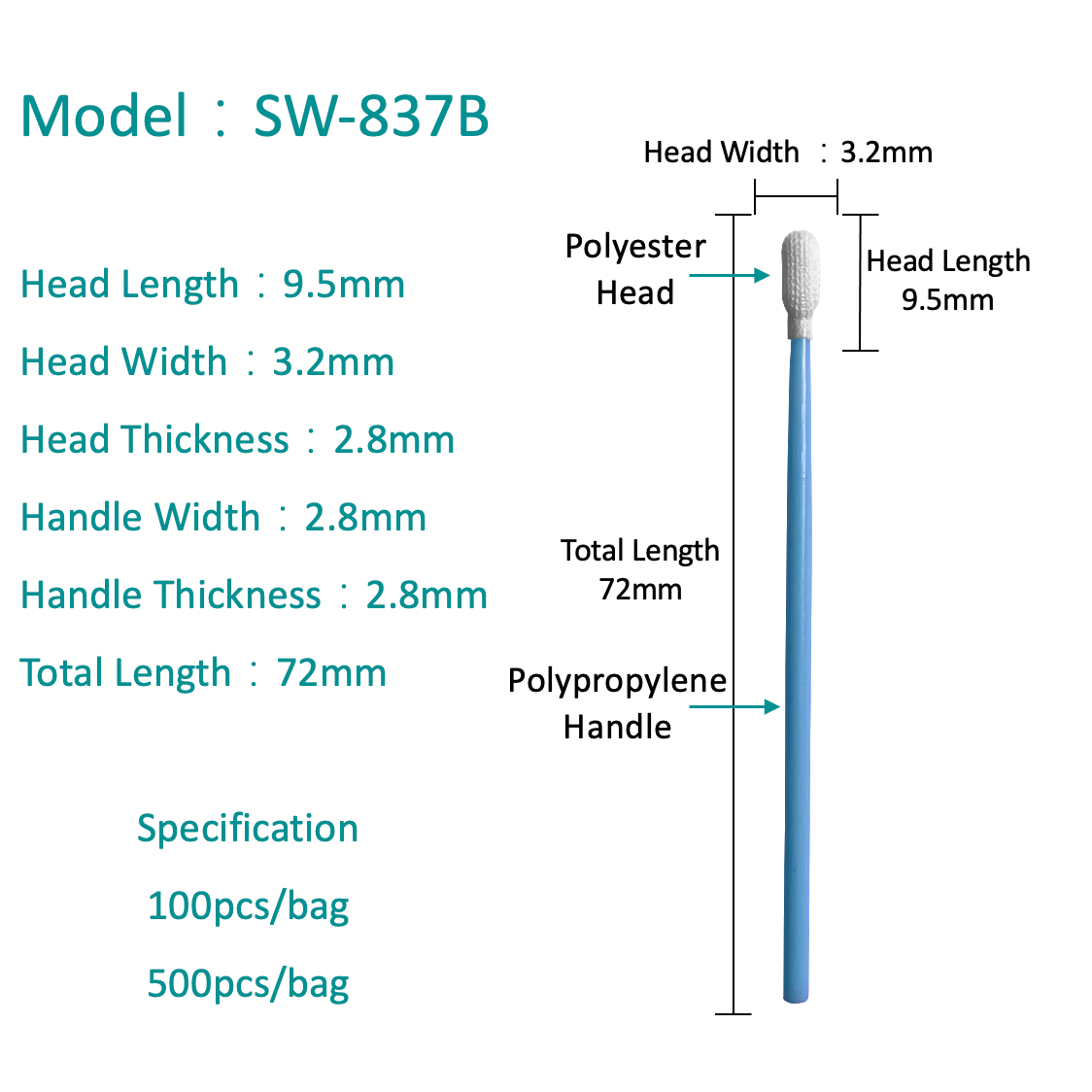
A polyester swab is a precision cleaning and sampling tool consisting of a polyester knit or woven tip bonded to a handle — typically made from polypropylene, nylon, or stainless steel. The tip material is a thermoplastic polyester fiber, most commonly polyethylene terephthalate (PET), processed into a tightly knit fabric that wraps around a foam or fiber core. Unlike cotton or foam swabs, polyester swabs release virtually no particles, fibers, or extractable residues, making them the preferred consumable in contamination-sensitive manufacturing and laboratory environments.
The defining characteristic of polyester knit tips is their continuous-filament construction. Polyester yarn is knit — not cut — around the swab core, which means there are no loose fiber ends to shed. This results in cleanliness levels that meet ISO Class 4 and Class 5 cleanroom requirements when the swabs are properly packaged and validated. For applications where even microscopic fiber contamination can cause yield loss or assay error, polyester outperforms natural fibers by a significant margin.
Polyester vs. Other Swab Materials
Understanding where polyester swabs outperform — and where they are sometimes substituted — requires a direct comparison with the other common swab tip materials: cotton, foam, and nylon/microfiber.
| Tip Material | Particle Shedding | Solvent Compatibility | Absorbency | Typical Use Case |
|---|---|---|---|---|
| Cotton | High | Limited (degrades in many solvents) | High | General-purpose, non-critical cleaning |
| Foam | Low–Medium | Moderate (swells in some solvents) | Very High | Fluid application, optical cleaning |
| Polyester | Very Low | Broad (IPA, acetone, MEK, EtOH) | Moderate | Cleanroom, PCB, disk drive, medical device |
| Nylon / Microfiber | Low | Good | Moderate–High | Surface sampling, forensics, diagnostics |
Cotton swabs are unsuitable for electronics and semiconductor cleaning because individual cotton fibers — typically 10–40 µm in diameter — can become lodged in component gaps and alter electrical performance. Foam swabs hold more fluid per unit area and release it more slowly, which is advantageous for lens cleaning but can leave residual extractables (from polyurethane foam off-gassing) that interfere with adhesion bonding processes. Polyester swabs occupy the intersection of low shedding and broad chemical resistance that neither cotton nor foam can match simultaneously.
Construction and Handle Materials
The performance of a polyester swab is determined not just by the tip but by the entire assembly. Handle selection depends on the chemical environment, the rigidity required, and whether the swab will contact sensitive substrates or high-voltage components.
Polypropylene Handles
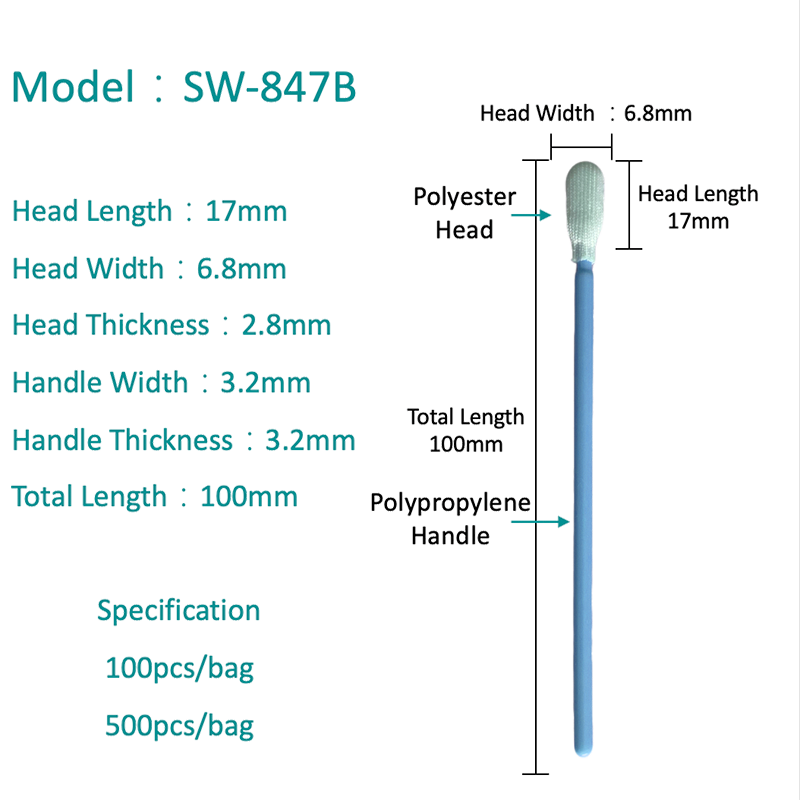
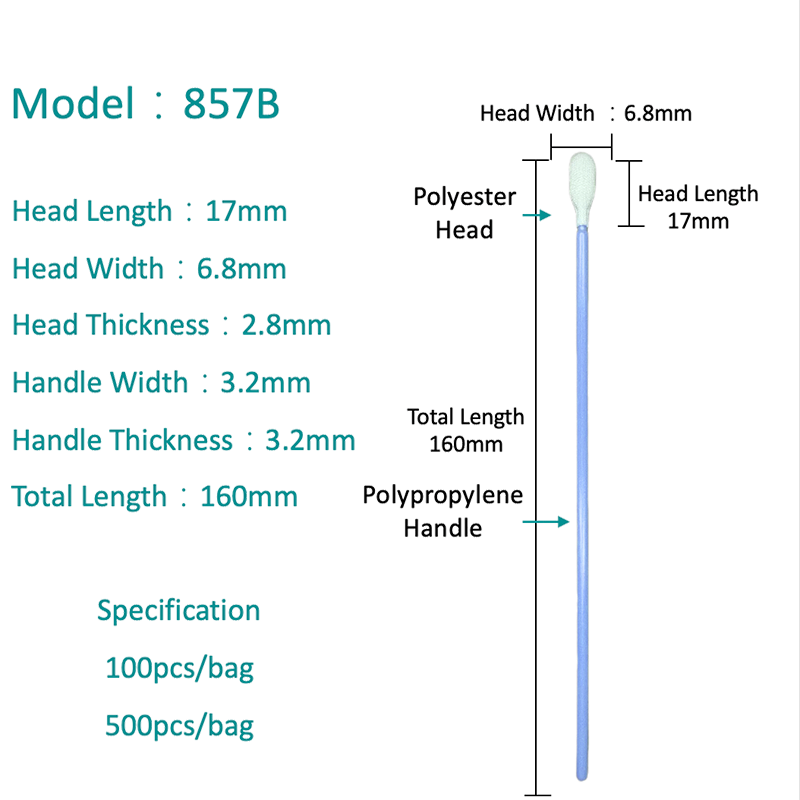
Polypropylene (PP) is the most common handle material for polyester swabs. It is chemically inert to most solvents used in electronics cleaning — isopropyl alcohol (IPA), ethanol, methyl ethyl ketone (MEK), and acetone — and it produces no ionic contamination. PP handles are lightweight and available in a full range of geometries: straight, bent-tip, paddle-tip, and ultra-miniature profiles for sub-millimeter cleaning tasks. The primary limitation is moderate heat resistance; PP handles are not recommended for use with heated solvents above 80°C.
Nylon Handles
Nylon handles offer higher rigidity than PP and are selected when the swab must apply consistent mechanical pressure — for instance, when scrubbing flux residues from PCB pads or cleaning threaded bores. One consideration: nylon is slightly hygroscopic and can absorb trace moisture in high-humidity storage environments, which matters in ultra-low-humidity semiconductor fabrication areas.
Stainless Steel and Carbon Fiber Handles
Stainless steel handles are specified for high-temperature cleaning applications (up to 260°C) and for disk drive head cleaning where dimensional precision below ±0.05 mm is required. Carbon fiber handles combine extreme rigidity with low weight and are used in aerospace component cleaning where handle deflection during application would cause surface marking. Both materials are more expensive than polymer handles and are therefore reserved for high-value component servicing.
Tip Geometry Options
Polyester swab tips are manufactured in several geometries to match specific cleaning targets:
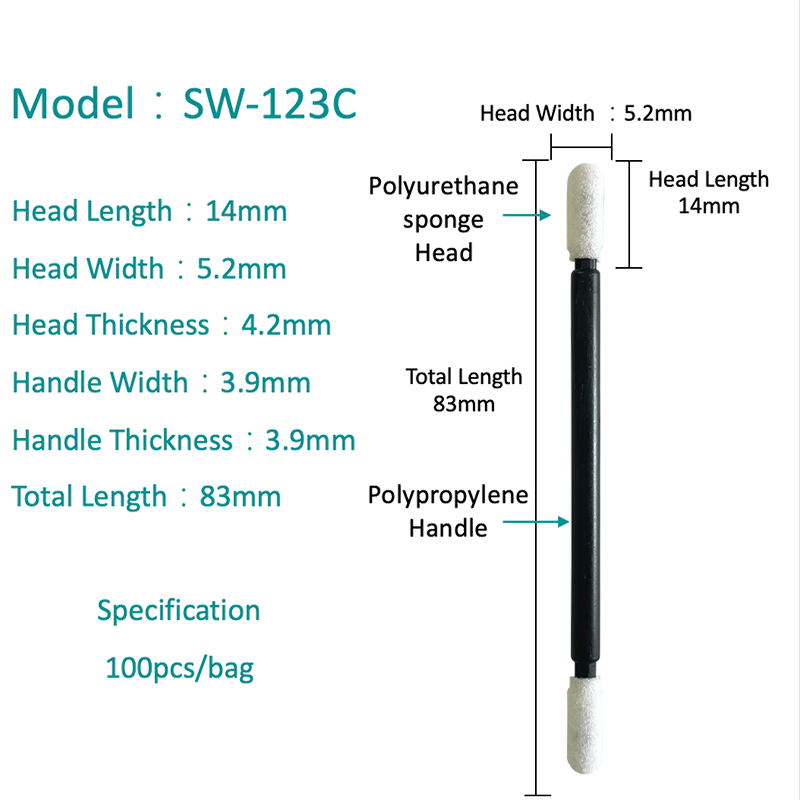
- Round/bulb tips: General-purpose; maximum contact area for flat surfaces
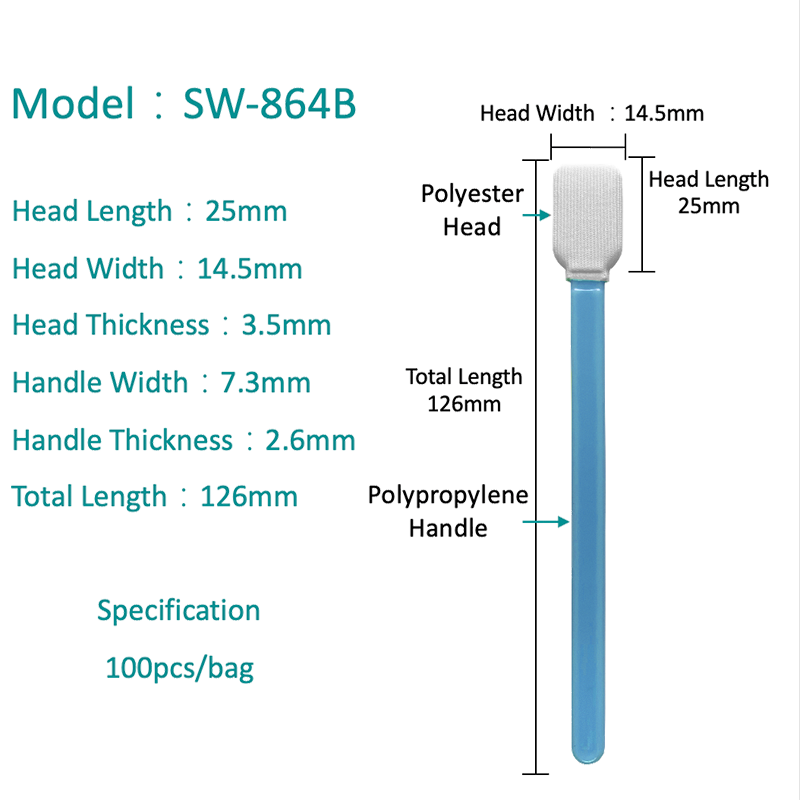
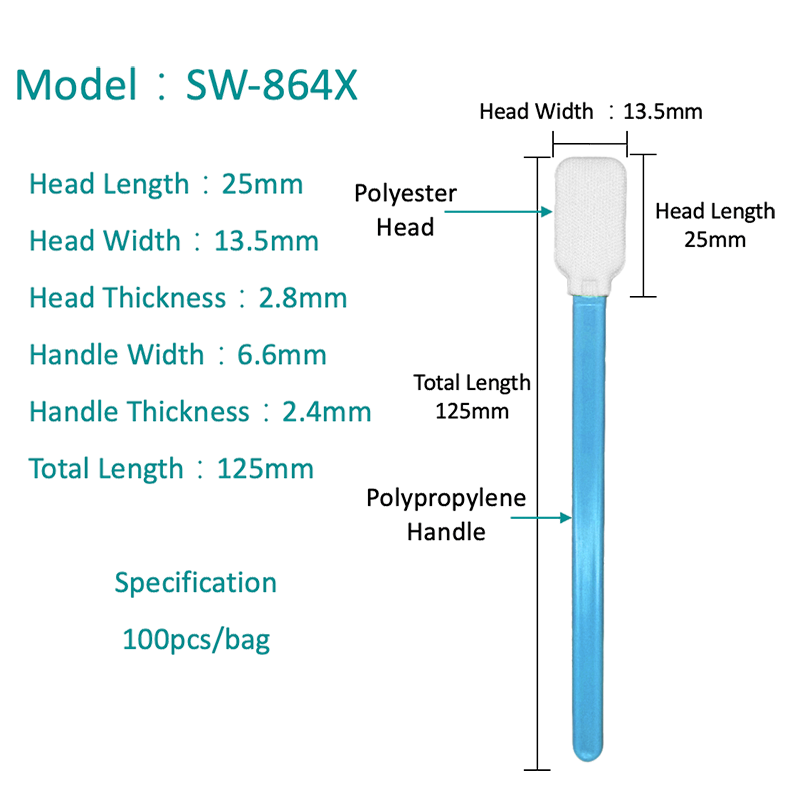
- Paddle tips: Flat profile for cleaning under SMD components and in recessed channels
- Pointed/tapered tips: For pin connectors, fiber optic ferrule end-faces, and micro-via cleaning
- Tube/hollow-core tips: For applying precise fluid volumes to small areas without oversaturation
- Mini and micro swabs: Tips as small as 1.5 mm diameter for sub-component cleaning in MEMS and watch movement assembly
Primary Applications of Polyester Swabs
Electronics and PCB Assembly
In printed circuit board manufacturing, polyester swabs are used to remove solder flux residues from specific areas — particularly around fine-pitch ICs, BGAs, and edge connectors — where automated cleaning systems cannot reach without risk of collateral damage. They are applied with IPA or specialized flux removers. IPC-7711/7721 rework and repair standards reference swab-based spot cleaning as the accepted method for localized residue removal. The absence of fiber contamination is critical here: a cotton fiber bridging two 0.1 mm-spaced BGA pads can cause a short circuit that survives automated optical inspection.
Semiconductor and Disk Drive Manufacturing
Hard disk drive (HDD) head-gimbal assembly cleaning is one of the most demanding polyester swab applications. The read/write head flies at a height of 3–5 nm above the disk surface; a single particle above 0.1 µm on the head face causes a head crash and data loss. Polyester swab tips for HDD applications are manufactured to particle counts below 1 particle per swab at 0.5 µm and above, verified by laser particle counter testing on every lot. Semiconductor wafer edge cleaning and photomask maintenance similarly rely on ISO Class 4-compatible polyester swabs pre-wetted with ultrapure water or dilute HF.
Fiber Optic Connector Cleaning
Fiber optic end-face contamination — dust, oil, or scratches on the ferrule face — is the leading cause of optical insertion loss in data center interconnects. IEC 61300-3-35 defines the pass/fail criteria for end-face cleanliness; most data center operators require insertion loss below 0.3 dB. Polyester swabs sized to standard ferrule diameters (1.25 mm for LC/MU, 2.5 mm for SC/ST/FC) are used in a one-pass dry or IPA-wet-then-dry cleaning sequence. The knit polyester tip abrades and lifts contamination without scratching the glass surface — a capability foam tips lack due to their compressibility.
Medical Device Manufacturing and Diagnostics
Polyester swabs are used extensively in medical device assembly for applying primers, adhesives, and coatings to small areas with controlled volume. In in-vitro diagnostics (IVD), polyester-tipped swabs serve as sample collection devices for surface environmental monitoring — swabbing equipment surfaces and counting recovered colony-forming units (CFUs) to verify cleaning validation in FDA-regulated facilities. The low extractables profile of polyester is essential here: cotton swabs introduce sugars and proteins that can interfere with microbiological assay results.
Pharmaceutical Cleaning Validation
FDA 21 CFR Part 211 and EU GMP Annex 15 require pharmaceutical manufacturers to demonstrate that manufacturing equipment is cleaned to defined residue limits between product changeovers. Swab sampling — using polyester swabs to mechanically collect residues from equipment surfaces — is one of the two accepted sampling methods (alongside rinse sampling). The swab is analyzed by HPLC, TOC, or microbiological testing. Polyester is specified over cotton because it delivers higher and more consistent analyte recovery rates; studies have shown polyester recovery rates for API residues of 85–98% compared to 60–80% for cotton in validated methods.
Aerospace and Defense
Avionics connectors, optical sensor windows, and gyroscope components require periodic cleaning during maintenance that cannot tolerate particle contamination. MIL-PRF-680 and NASA contamination control standards reference non-shedding swabs for these cleaning tasks. Polyester swabs pre-wetted with NASA-approved cleaning solvents are also used in spacecraft assembly cleanrooms to clean bonding surfaces prior to adhesive application.
Cleanroom Packaging and Validation Standards
A polyester swab's cleanliness at the point of manufacture is only preserved if it is packaged and validated appropriately. Cleanroom-grade polyester swabs are processed in ISO Class 5 or Class 4 environments and packaged under equivalent conditions. Common packaging formats include:
- Individually wrapped in heat-sealed polyethylene bags — the highest cleanliness standard; each swab is a single-use sterile unit
- Peel-pouches (5 or 10 per pouch) — for moderate-cleanliness applications where per-unit packaging cost must be controlled
- Bulk jar or bag (50–500 units) — for non-critical industrial cleaning where particle budgets are relaxed
Reputable manufacturers provide lot-level certificates of conformance (COC) documenting particle counts (tested per IEST-RP-CC004 or equivalent), non-volatile residue (NVR) levels in µg per swab, and — for medical applications — bioburden and endotoxin test results. For pharmaceutical cleaning validation, the swab brand and lot number must be documented in the validation protocol, as a change in swab supplier requires partial revalidation under ICH Q7 guidance.
Some critical applications require gamma-irradiated sterile polyester swabs (typically 25 kGy minimum absorbed dose), supplied with a sterility assurance level (SAL) of 10⁻⁶. Gamma irradiation does not significantly degrade polyester fiber properties at these dose levels, making it the preferred sterilization method over EO gas (which can leave residual ethylene oxide) or autoclave (which causes thermal distortion of polypropylene handles).
Selecting the Right Polyester Swab: Key Parameters
With dozens of tip sizes, handle materials, and packaging options available, selecting the correct polyester swab requires matching the swab specification to the cleaning or sampling task:
- Tip size: Match the tip width to the feature being cleaned. A 6 mm round tip suited for a BGA pad will over-clean surrounding components; a 1.5 mm micro-tip is needed for connector pin cleaning.
- Handle rigidity: Stiff handles deliver consistent pressure for scrubbing; flexible handles reduce the risk of surface marring on delicate coatings.
- Solvent compatibility: Confirm the handle polymer is compatible with the cleaning solvent at the operating concentration. Acetone, for instance, can stress-crack certain grades of polystyrene handles.
- NVR specification: For semiconductor and HDD applications, require NVR below 100 µg per swab; for pharmaceutical sampling, specify the NVR limit appropriate to your TOC method.
- Sterility requirement: Medical device assembly and aseptic fill environments require sterile, individually wrapped swabs with documented SAL; industrial electronics cleaning typically does not.
- Static dissipation: Standard polyester is an insulator. For ESD-sensitive component cleaning, specify carbon-loaded or ESD-treated polyester swab tips with surface resistivity below 10⁹ Ω/sq.
- Handle length: Optical fiber ferrule cleaning requires short, rigid swabs for controlled insertion depth; equipment interior cleaning may require extended handles of 150 mm or longer.

 ADDRESS
 CONTACT
 FAX
FAX EMAIL
EMAIL
