



 English
  中文简体
中文简体 
Lens Microfiber Ccd Sensor Cleaning Swab Manufacturers
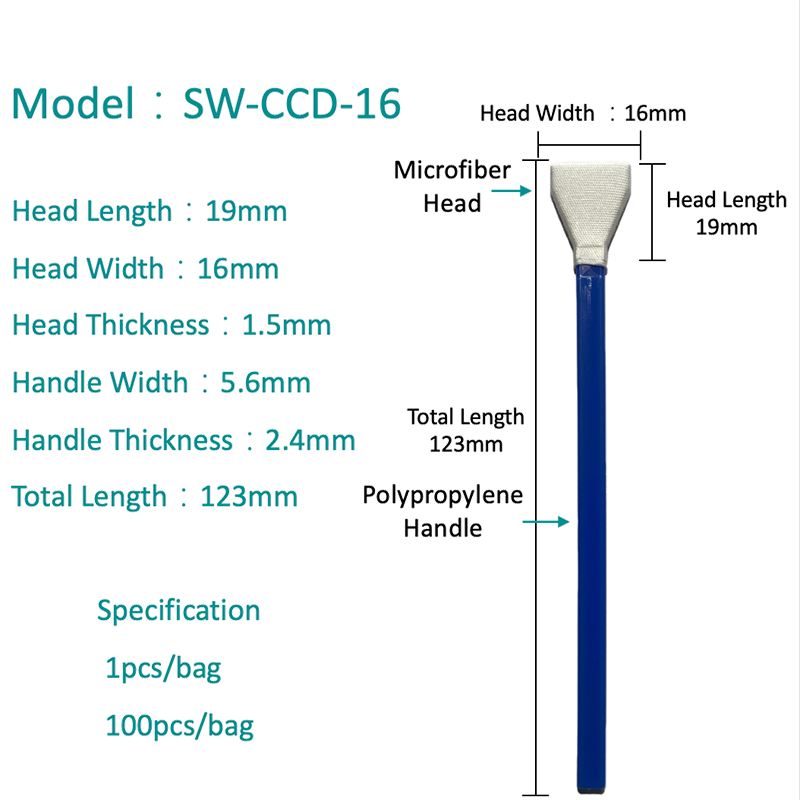
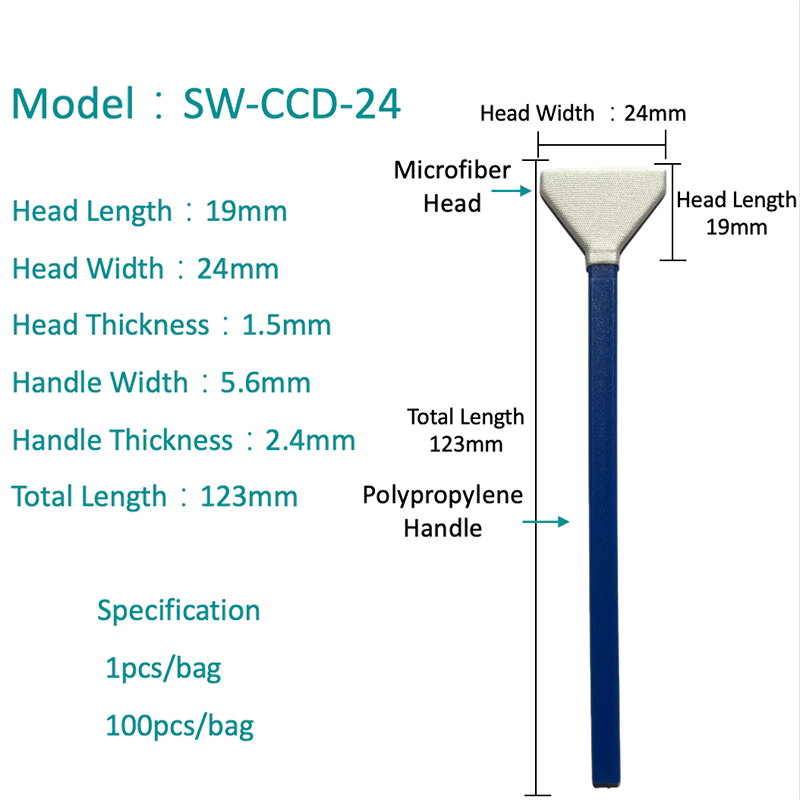
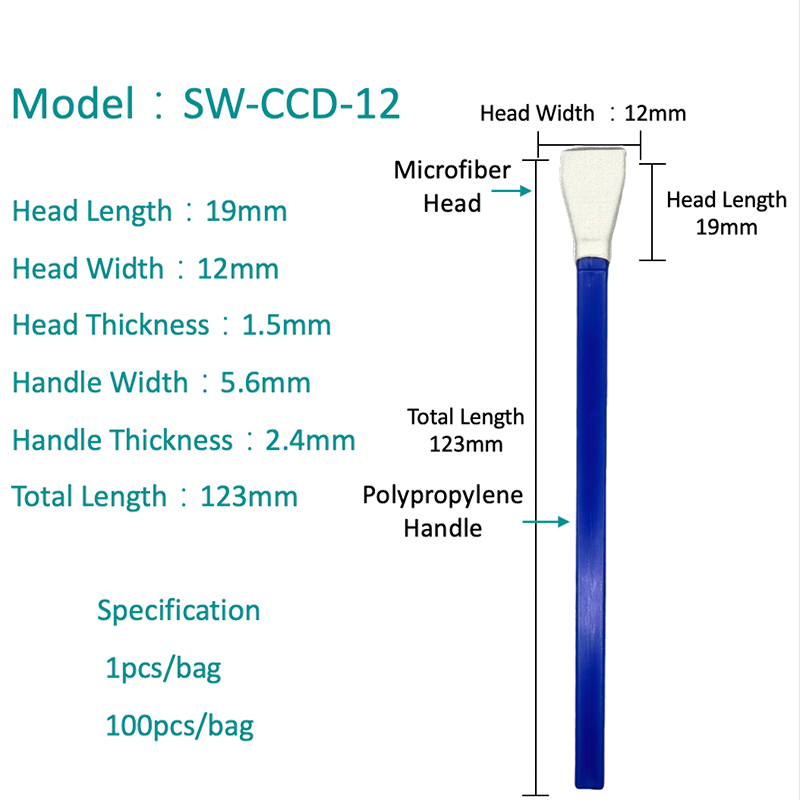
Product Description
The CCD Cleaning Swab, also known as the Sensor Cleaning Swab, features a wiping head made from ultra-fine silk fibers, which are woven to create a soft texture that is gentle on lenses and CCD surfaces, ensuring no damage. The swab is dust-free, having undergone a dust-free cleaning process and vacuum-sealed in a Class 10 cleanroom. The wiping head is pre-moistened with IPA, eliminating the need for any additional lens-cleaning solutions. This swab is primarily designed to clean sensors in various cameras, smartphones, optical lenses, and computer displays, helping to maintain sensor sensitivity and display clarity.
Cleaning Method
The swab is crafted from professional-grade ultra-fine microfiber fabric, which is soft, easy to use, and dust-free, making it ideal for cleaning photographic lenses of all sizes.
1. For cleaning larger lenses or screens:
Begin at the center and spiral outwards, or clean methodically from one side to the other.
2. Cleaning the CCD of a digital camera:
Select the exposure mode (M), and then set the shutter speed for the door (B), the shutter button will be pressed completely down for a long time. At this point, the reflector is raised and the CCD is displayed in front of your eyes. Clean up by blowing on the CCD with an air blower, and this time the camera lens aperture should be tilted downward. Note that the front end of the earwax ball does not touch the CCD, then use the CCD wipe stick to wipe from side to side of the order word.
Suzhou Zhuojing Cleanroom Technology Co., Ltd.
Suzhou Zhuojing Dust-free Technology Co., Ltd. is a specialized manufacturer dedicated to the research, development, production, and sales of dust-free cleaning cotton swabs, dust-free wipers, dust-free wipping papers and various dust-free anti-static consumables.
We are China Wholesale Lens Microfiber Ccd Sensor Cleaning Swab Factory and OEM/ODM Lens Microfiber Ccd Sensor Cleaning Swab Manufacturers. Our team comprises a group of engineering technicians engaged in the development of dust-free products and highly skilled marketing personnel, ensuring the quality of our products and our sales services. Our clientele spans across the nation, and we also provide OEM services to international peers in the same industry.
Our factory is equipped with cleanrooms ranging from Class 10 to Class 1000, and we have introduced advanced global dust-free cleaning equipment. The cleaning process utilizes ultra-pure water with a purity of up to 18 mega-ohm, ensuring that all dust-free products undergo production within a controlled environment. They are then vacuum-sealed to maintain their cleanliness before being delivered to our customers. Our specialized dust-free production, washing, and drying processes guarantee that our products meet high standards of cleanliness.
We are committed to the field of dust-free and anti-static technology, offering a range of services including the design, manufacturing, sales, OEM cooperation, and production and sales of various anti-static clean products. Our products are widely used in industries such as semiconductors, microelectronics, integrated circuits, precision instruments, aerospace, and pharmaceuticals.
At our company, customer needs are always important, and we pay more attention to our customers' needs. We are continuously striving for high technology and high quality, which are our goals. Developing new products and promoting new services are the driving forces behind our development. Honesty, integration, responsibility, and innovation are the guiding principles of our business philosophy.
Adhering to the quality policy of "scientific management, quality-oriented continuous improvement, and customer satisfaction," we are eager to collaborate with clients both domestically and internationally. We look forward to your partnership as we work together towards a bright future.
News
-
Sponge Swabs for Medical Use: Wound, Surgical & Dental Guide
Medical & Healthcare Supplies Sponge Swabs for Medical Use: Wound Care, Surgical, and Dental Applications Sponge swabs show up across nearly every corner o...
Read More -
How to Use a Sponge Swab for Surface Sampling: Complete Guide
Lab & Sampling Supplies How to Use a Sponge Swab for Surface Sampling Sponge swabs are a standard tool for collecting surface samples in food safety, envir...
Read More -
Cleanroom Swabs: Materials, Types & How to Choose
Swab material is the single biggest factor separating a clean, residue-free wipe from a swab that leaves fibers, scratches a sensitive surface, or introduces ...
Read More -
Poly Swabs, Microfiber Swabs & Swab Types Explained
Poly Swabs, Microfiber Swabs, and Swab Types Explained Swabs are one of the simplest tools in precision cleaning and quality control, yet the differences betw...
Read More
Message Feedback
Industry Knowledge
Why Microfiber Structure Matters More Than You Think
When selecting a Lens Microfiber Swab, the fiber splitting technology directly determines whether the swab lifts particles or simply pushes them around. Premium swabs use splittable bicomponent fibers that create wedge-shaped channels, capable of trapping sub-micron debris through capillary action rather than relying solely on adhesive forces. This mechanical entrapment is particularly important for CCD and CMOS sensor surfaces, where a 1μm particle can already cover multiple pixel sites.
Suzhou Zhuojing Dust-free Technology Co., Ltd. applies this principle in controlled cleanroom production, ensuring that every swab tip maintains consistent fiber density after ultrapure water washing. The absence of fiber shedding is not an accident—it results from thermal bonding techniques that eliminate chemical binders, reducing outgassing risks during sensor contact.
From a practical standpoint, technicians should assess fiber structure under magnification before trusting a swab on high-value optical assemblies. Look for uniform split-fiber distribution and sealed edge construction, both indicators of a swab engineered for precision rather than general-purpose wiping.
Cleanroom Manufacturing Chain: The Hidden Half of Swab Performance
A swab’s cleanliness rating is not defined by its packaging label alone—it is built across every stage of production, from raw polymer handling to final vacuum sealing. In facilities like those operated by Suzhou Zhuojing Dust-free Technology Co., Ltd., the journey from Class 1000 pre-wash areas to Class 10 finishing zones represents a deliberate contamination cascade control. Each transition reduces airborne particle loads before the product enters its most critical processing steps.
The washing process deserves particular attention. Using 18 mega-ohm ultrapure water, as practiced in advanced dust-free plants, removes ionic residues that can cause microscopic corrosion on sensor contacts. Post-wash drying under HEPA-filtered airflow prevents recontamination—a step often overlooked in lower-tier production but critical for maintaining non-volatile residue levels below 0.1mg per swab.
For cleanroom managers, auditing the manufacturing chain of swab suppliers offers more predictive value than batch-level certificates alone. Consistent environmental monitoring data and validated cleaning protocols ensure that every Lens Microfiber Ccd Sensor Cleaning Swab leaves the factory with reproducible cleanliness, rather than relying on post-production inspection luck.
Solvent Compatibility: Preventing Swab Breakdown During Sensor Cleaning
Even high-purity microfiber can fail if the swab head construction is incompatible with the chosen cleaning solvent. Key concerns include adhesive dissolution in IPA or acetone, which leaves sticky residues on optical surfaces, and thermoplastic swelling that alters tip geometry mid-stroke. Swabs engineered without adhesives—using ultrasonic or thermal bonding—avoid the first failure mode entirely.
Our development work at Suzhou Zhuojing Dust-free Technology Co., Ltd. focuses on matching swab substrate, bonding method, and handle material to common solvent families. For instance, polypropylene handles resist aromatic hydrocarbons better than standard polystyrene, making them suitable for aggressive flux removers used in PCB camera module cleaning.
| Solvent Type | Handle Compatibility | Tip Bonding Method | Residue Risk |
|---|---|---|---|
| Isopropyl Alcohol (IPA) | PP / Acrylic | Thermal bond preferred | Low if adhesive-free |
| Acetone | PP only | Ultrasonic bond | Medium – test first |
| Deionized Water | Universal | Any clean bond | Very low |
Field technicians should always verify a swab’s chemical resistance chart before pairing it with specialty cleaners. A quick bench test—wetting the swab head and wiping a clean glass slide followed by microscopic inspection—can prevent costly sensor rework.
Static Dissipation: The Often-Ignored Factor in Sensor Safe Cleaning
Moving a dry or lightly moistened swab across a CCD sensor generates triboelectric charges that can reach hundreds of volts, sufficient to damage unprotected CMOS circuitry. While many operators focus on grounding wrist straps and mats, the swab itself can act as a charge accumulator if not designed with static-dissipative properties.
Advanced cleanroom swab designs incorporate conductive fibers or carbon-loaded handles to provide a path to ground when used in conjunction with grounded operators. Surface resistivity in the range of 10⁶ to 10⁹ ohms per square allows controlled charge bleed-off without creating a short-circuit risk. At Suzhou Zhuojing Dust-free Technology Co., Ltd., we have observed that even in high-humidity cleanrooms, untreated polyester swabs can retain charge, while properly engineered dissipative swabs neutralize within milliseconds after contact with a grounded surface.
The practical takeaway is straightforward: for any sensor valued above a few hundred dollars, use swabs verified for static-dissipative performance and include swab grounding checks in the standard operating procedure. Combining dissipative swab technology with controlled humidity above 40% RH provides a robust defense against invisible ESD events that gradually degrade sensor performance.

The information provided on this website is intended for use only in countries and jurisdictions outside of the People's Republic of China.
REQUEST A FREE QUOTE
 ADDRESS
No. 93 Weihe Road, Suzhou Industrial Park, Jiangsu Province
 CONTACT
 FAX
FAX EMAIL
EMAILCopyright © Suzhou Zhuojing Cleanroom Technology Co., Ltd. All Rights Reserved.
Wholesale Lens Microfiber Ccd Sensor Cleaning Swab Manufacturers
