



 English
  中文简体
中文简体 
Microfiber Cleanroom Polyester Swab Manufacturers
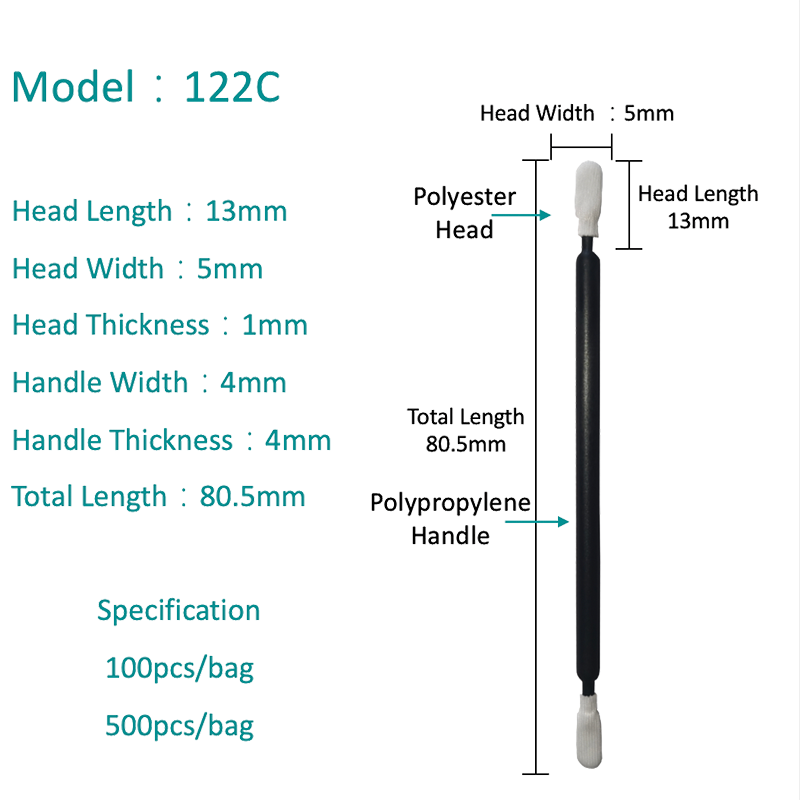
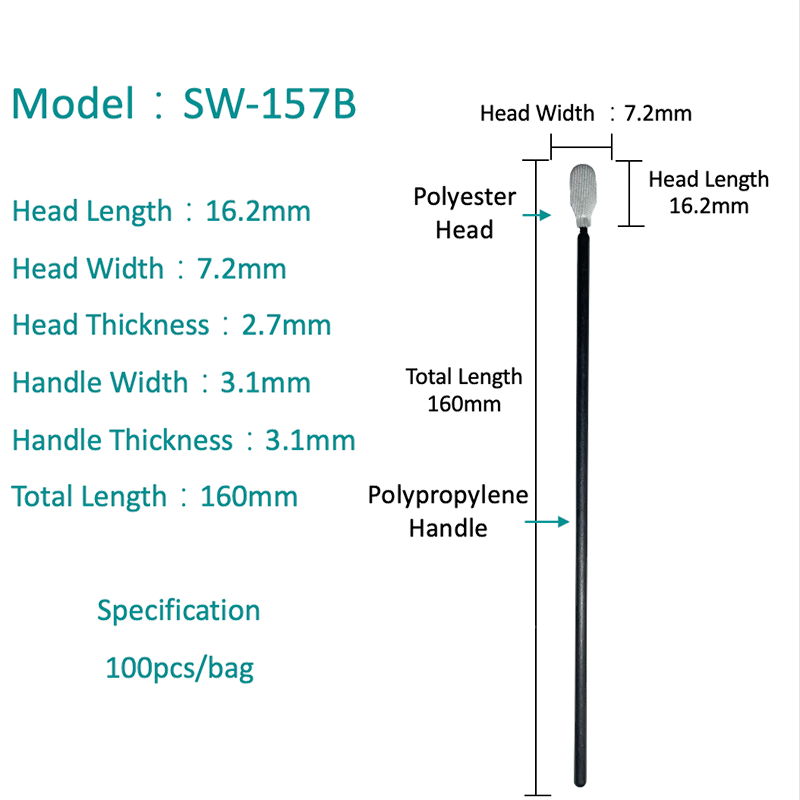
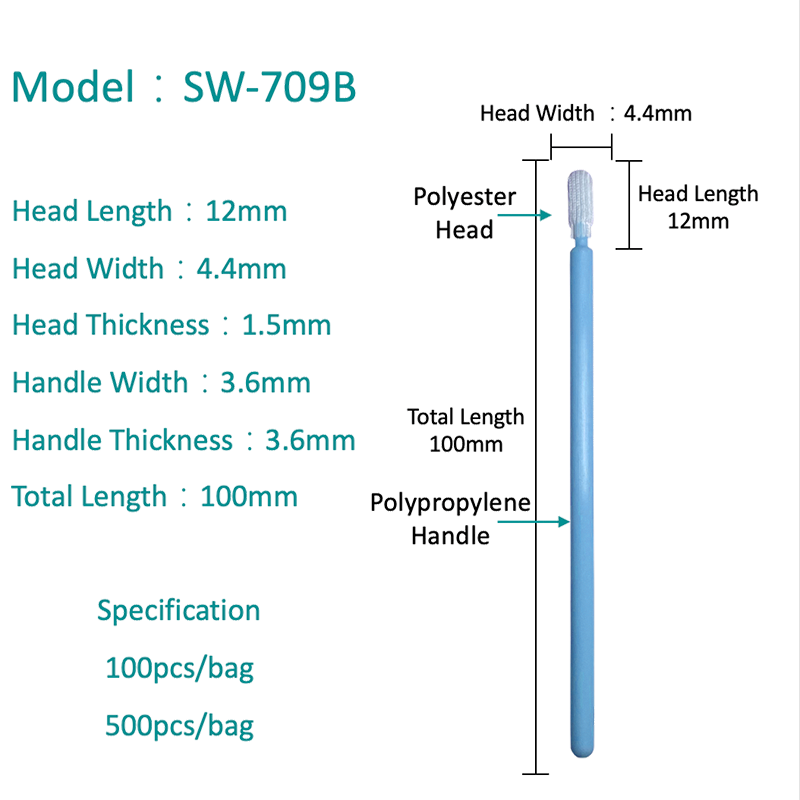
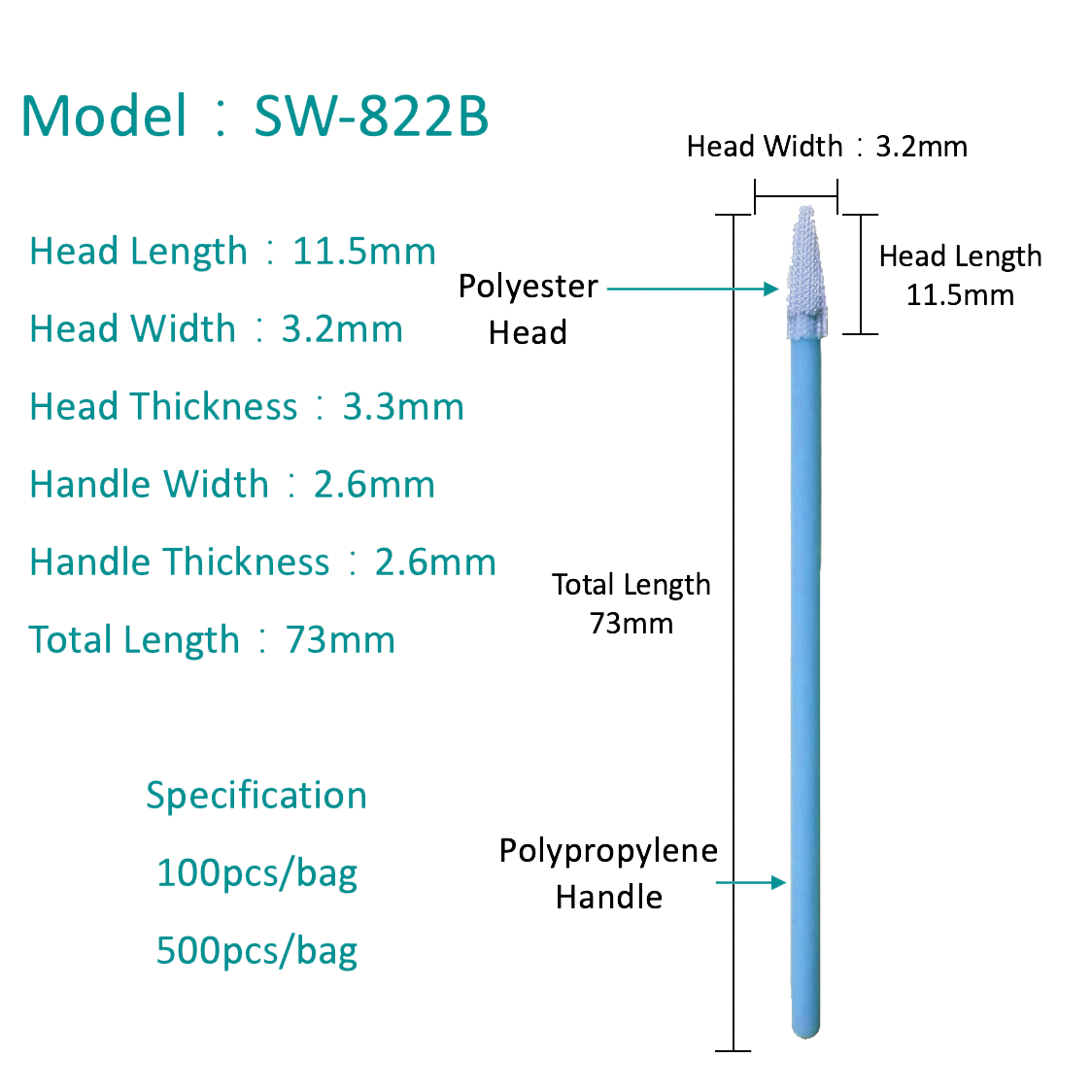
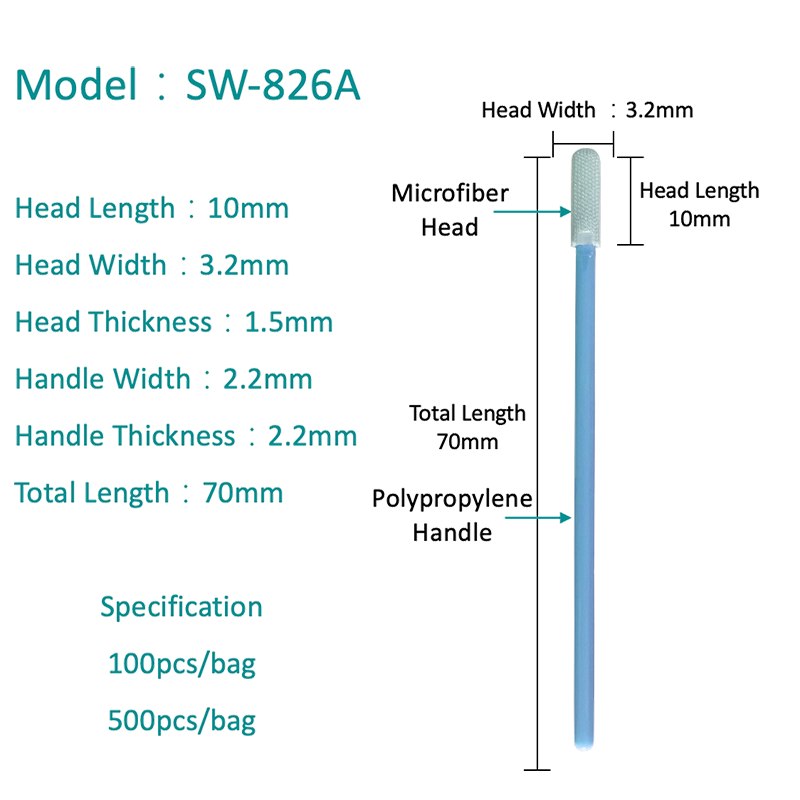
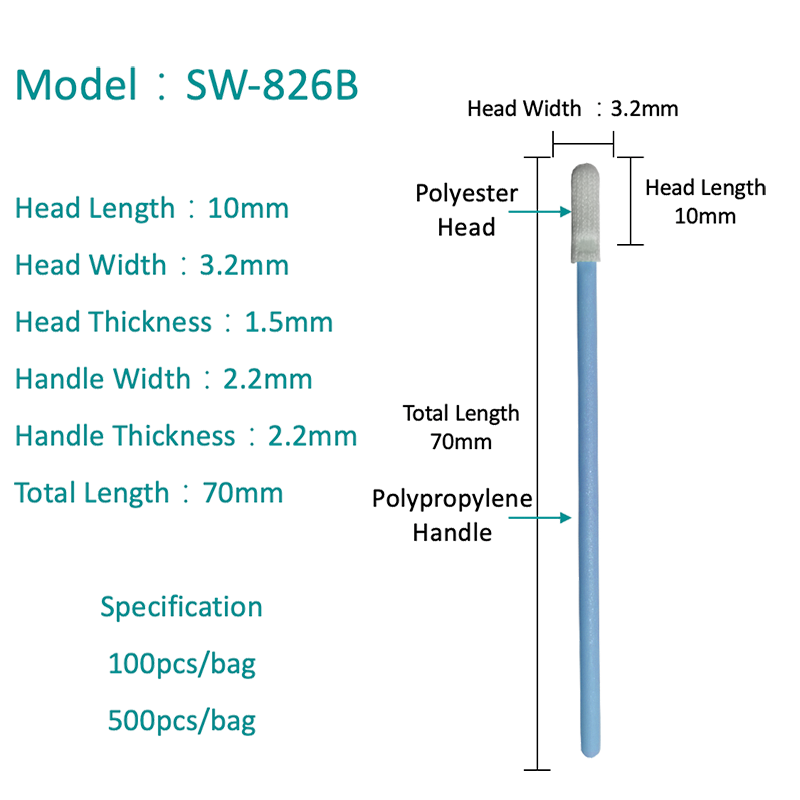
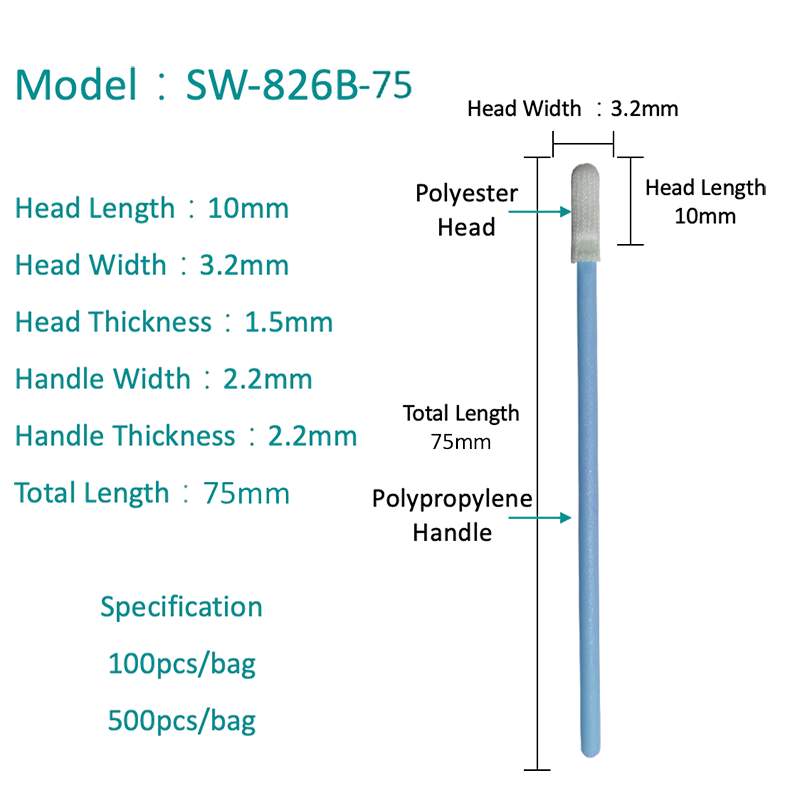
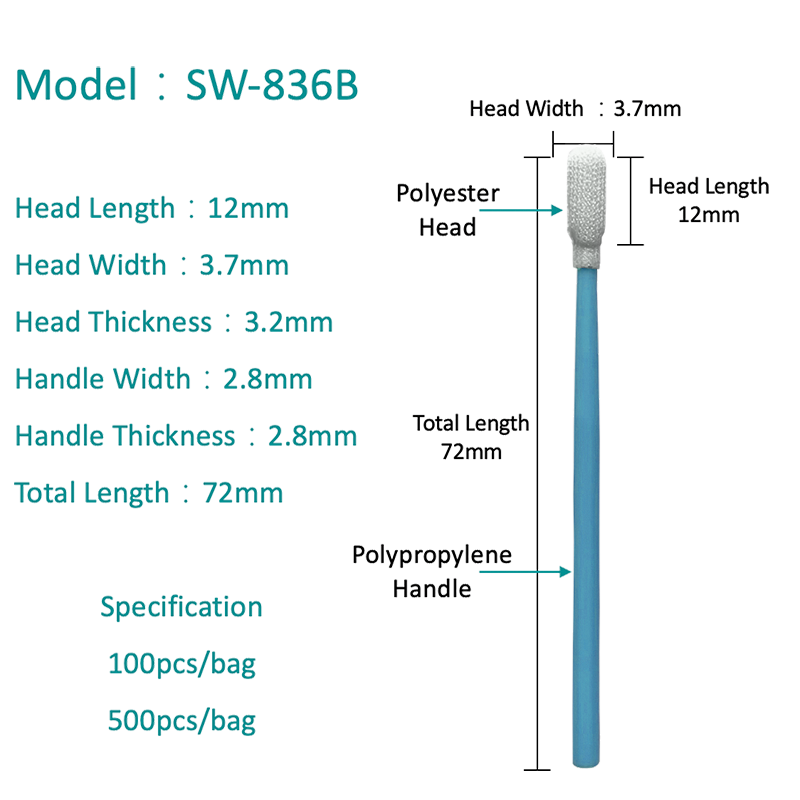
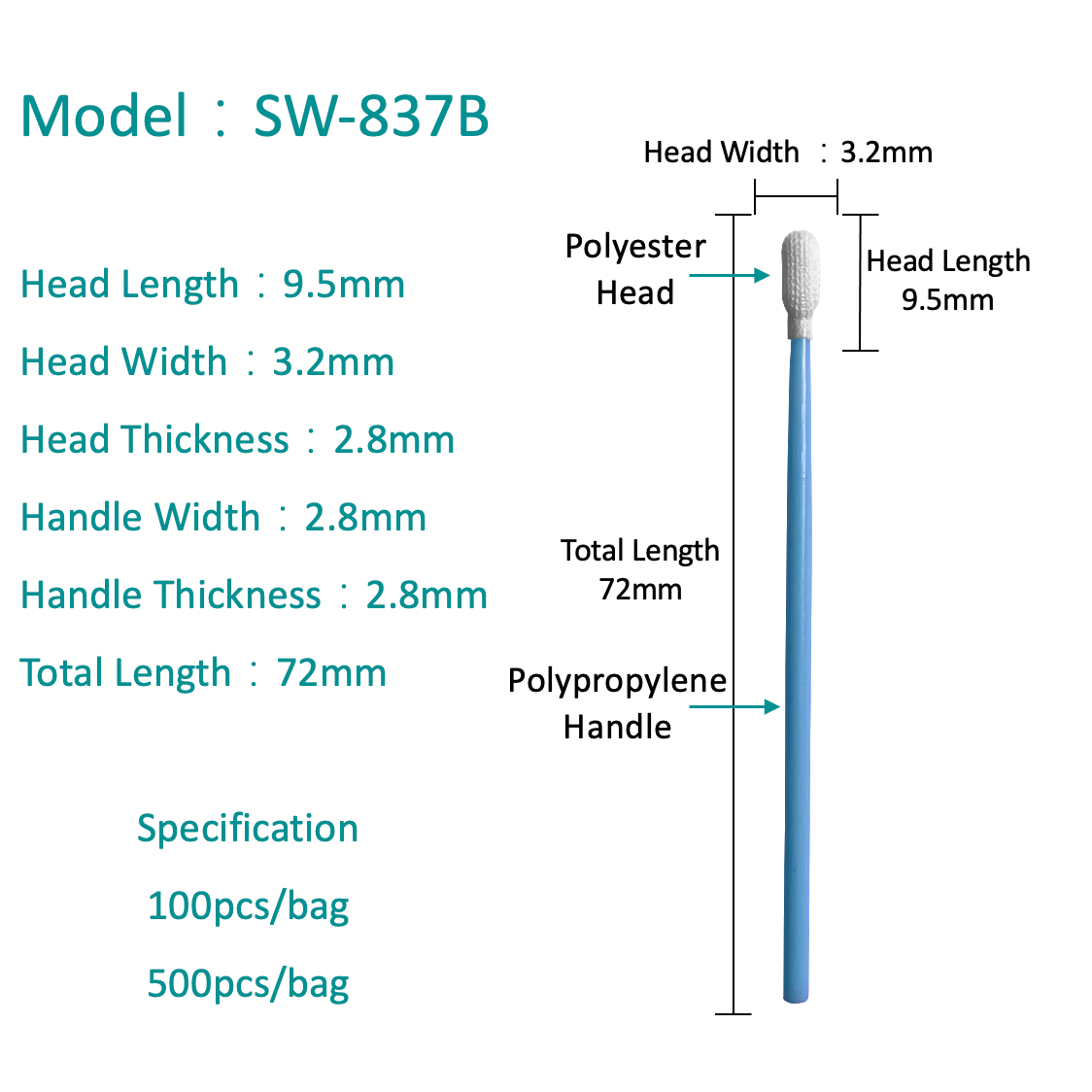
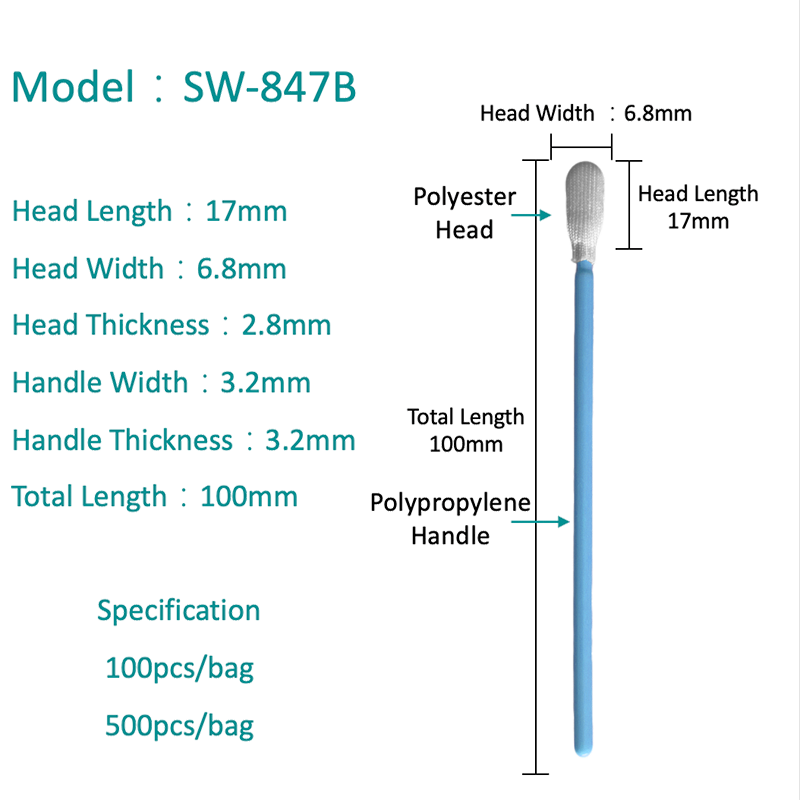
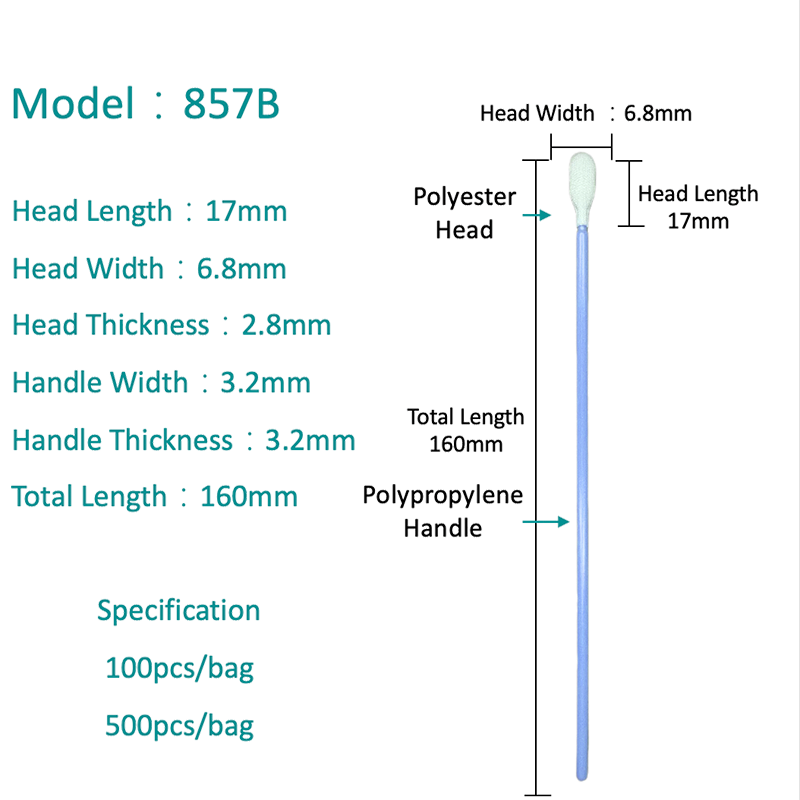
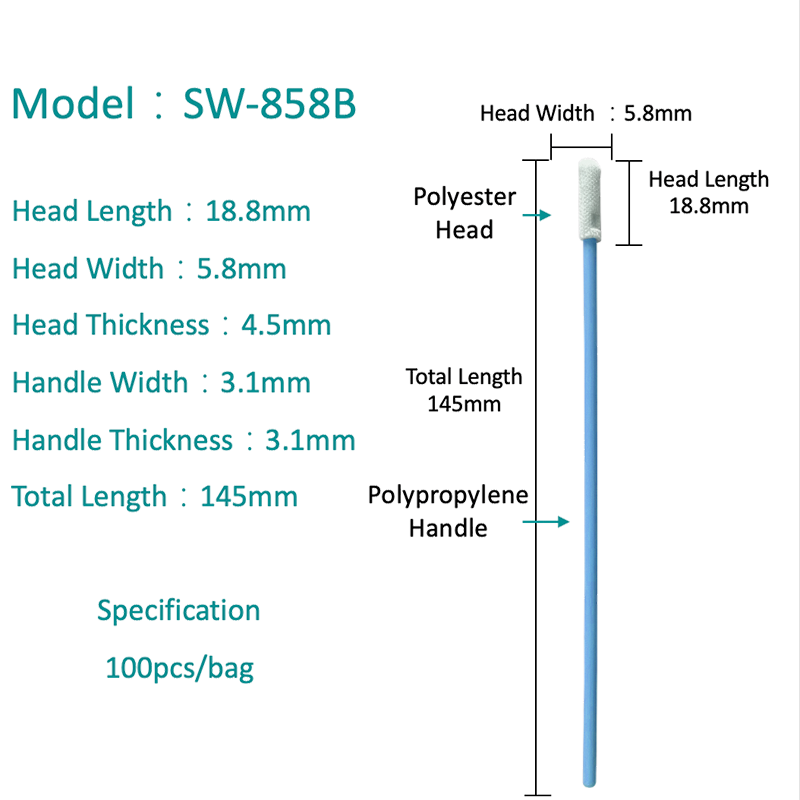
Cleanroom wipes are meticulously crafted from polyester fibers. The edges are sealed with advanced laser technology, significantly reducing fiber shedding and the generation of lint. They undergo a rigorous cleaning process with ultra-pure water of 17.5MΩ or higher and are packaged within a Class 10-1000 cleanroom environment.
Outstanding Features:
1. Good liquid absorption capabilities.
2. Precise laser-cut edge sealing technique.
3. Less residue after contact with chemical solvents.
4. Resistant to acids, alkalis, and solvents.
Application Scope:
These clothes are used across industries such as liquid crystal displays, semiconductors, flexible circuit boards, and pharmaceuticals. Customization in size and packaging is available to meet specific client requirements.
Types of Heads of Cleanroom Swabs:
The heads can be categorized based on the fabric and their specific functions and performance. Here are the main types:
A: Knitted Nylon Cloth (Good Abrasion-Resistant)
B: Knitted Microfiber (For Delicate Dust Removal, Moderate Abrasion Resistance)
C: Woven Microfiber (Specialized for Fiber Optic Cleaning)
D: Knitted Polyester (The Fabric Has a Vertical Stripe Pattern with Deep Grooves for Holding More Debris)
All of these dust-free cloth heads are capable of being cleaned to a high standard of 100-class, making them suitable for use in the electronics industry.
Suzhou Zhuojing Cleanroom Technology Co., Ltd.
Suzhou Zhuojing Dust-free Technology Co., Ltd. is a specialized manufacturer dedicated to the research, development, production, and sales of dust-free cleaning cotton swabs, dust-free wipers, dust-free wipping papers and various dust-free anti-static consumables.
We are China Wholesale Microfiber Cleanroom Polyester Swab Factory and OEM/ODM Microfiber Cleanroom Polyester Swab Manufacturers. Our team comprises a group of engineering technicians engaged in the development of dust-free products and highly skilled marketing personnel, ensuring the quality of our products and our sales services. Our clientele spans across the nation, and we also provide OEM services to international peers in the same industry.
Our factory is equipped with cleanrooms ranging from Class 10 to Class 1000, and we have introduced advanced global dust-free cleaning equipment. The cleaning process utilizes ultra-pure water with a purity of up to 18 mega-ohm, ensuring that all dust-free products undergo production within a controlled environment. They are then vacuum-sealed to maintain their cleanliness before being delivered to our customers. Our specialized dust-free production, washing, and drying processes guarantee that our products meet high standards of cleanliness.
We are committed to the field of dust-free and anti-static technology, offering a range of services including the design, manufacturing, sales, OEM cooperation, and production and sales of various anti-static clean products. Our products are widely used in industries such as semiconductors, microelectronics, integrated circuits, precision instruments, aerospace, and pharmaceuticals.
At our company, customer needs are always important, and we pay more attention to our customers' needs. We are continuously striving for high technology and high quality, which are our goals. Developing new products and promoting new services are the driving forces behind our development. Honesty, integration, responsibility, and innovation are the guiding principles of our business philosophy.
Adhering to the quality policy of "scientific management, quality-oriented continuous improvement, and customer satisfaction," we are eager to collaborate with clients both domestically and internationally. We look forward to your partnership as we work together towards a bright future.
News
-
Sponge Swabs for Medical Use: Wound, Surgical & Dental Guide
Medical & Healthcare Supplies Sponge Swabs for Medical Use: Wound Care, Surgical, and Dental Applications Sponge swabs show up across nearly every corner o...
Read More -
How to Use a Sponge Swab for Surface Sampling: Complete Guide
Lab & Sampling Supplies How to Use a Sponge Swab for Surface Sampling Sponge swabs are a standard tool for collecting surface samples in food safety, envir...
Read More -
Cleanroom Swabs: Materials, Types & How to Choose
Swab material is the single biggest factor separating a clean, residue-free wipe from a swab that leaves fibers, scratches a sensitive surface, or introduces ...
Read More -
Poly Swabs, Microfiber Swabs & Swab Types Explained
Poly Swabs, Microfiber Swabs, and Swab Types Explained Swabs are one of the simplest tools in precision cleaning and quality control, yet the differences betw...
Read More
Message Feedback
Industry Knowledge
Knitted Polyester vs. Microfiber: What the Fabric Structure Actually Determines
The terms "polyester swab" and "microfiber swab" are sometimes used interchangeably in procurement, but they describe meaningfully different fabric constructions with different performance profiles — and selecting the wrong one for a specific application produces consistently inferior cleaning results regardless of how the swab is used. Understanding the structural difference between the two is the practical starting point for correct swab selection in cleanroom environments.
Knitted polyester is constructed from continuous-filament polyester yarn in an interlocking loop structure, typically producing a vertical stripe or deep groove pattern on the fabric surface. This groove geometry is functionally significant: the channels physically trap and hold larger particles and debris during the wiping stroke, retaining them within the fabric structure rather than pushing them ahead of the swab tip. The continuous-filament construction means there are no internal yarn discontinuities — no cut ends or short fibers within the fabric body — giving knitted polyester its characteristic ultra-low particle generation under the abrasion conditions of precision cleaning tasks. This construction also gives the swab tip a firmer contact surface that transmits scrubbing pressure effectively against dried flux residues, adhesive deposits, and baked-on contaminants that softer materials cannot dislodge.
Microfiber, by contrast, uses fibers whose diameter is measured in micrometers — typically 0.8 to 1.2 microns — producing a surface area per gram of fabric that is orders of magnitude larger than standard polyester yarn. This high surface area creates strong capillary action and van der Waals attraction that pulls fine particles, oils, and sub-micron contaminants into the fiber structure on contact. Microfiber is the appropriate choice when the cleaning objective is removal of fine particulate and oil residue from sensitive optical or electronic surfaces where mechanical abrasion from a firmer fabric would risk surface damage. As a general rule: use knitted polyester for scrubbing and chemical cleaning strength; use microfiber for polishing and fine particle removal on delicate substrates. A microfiber cleanroom polyester swab combines both fiber types within a single product line, covering both use cases from a single supplier relationship.
Why Laser Edge Sealing Is Not a Marketing Feature
Edge sealing method is one of the most consequential construction decisions in polyester swab manufacturing, and it is one that procurement teams frequently treat as a secondary specification after head size and handle length. The practical significance becomes clear when considering the failure mode that unsealed or mechanically-cut edges create: at every cut fiber end along the head perimeter, the polyester yarn is terminated by a free end that is mechanically loaded during every wiping stroke. These free ends progressively loosen under the lateral drag force of the wiping motion and eventually release as fiber particles onto the cleaned surface — precisely the contamination source the swab is intended to eliminate.
Laser edge sealing addresses this at the material level. The CO₂ laser beam vaporizes the polyester along the cut line while simultaneously melting and fusing the fiber ends at the cut boundary, creating a thermally-sealed perimeter in which the polymer chains are bonded together rather than left as free filament ends. The result is a sealed, fray-free edge from which no fibers can release under normal wiping conditions — including the lateral shear forces generated when the swab tip contacts component lead edges, connector housing walls, and rough substrate surfaces. For swabs used in ISO Class 4–6 semiconductor and optical manufacturing environments where particle counts at workstations are actively monitored, the difference between a laser-sealed and an unsealed polyester head can be a traceable contamination source in production quality records.
Suzhou Zhuojing's polyester swab manufacturing process applies laser edge sealing as standard across the product range, with cleanroom packaging in Class 10 to Class 1000 environments and ultra-pure water at 18 mega-ohm purity used throughout the laundering process — conditions that ensure the edge-sealing investment is not compromised by post-processing particle recontamination before the swab reaches the end user.
Head Fabric Categories and Their Application Logic
Polyester cleanroom swab heads are not a single material category — they subdivide into at least four distinct fabric types, each optimized for a different cleaning mechanism. Matching the fabric type to the cleaning task determines whether the swab captures and retains the target contamination or simply redistributes it.
- Knitted Nylon: Higher abrasion resistance than polyester, suited for scrubbing tasks on harder substrate surfaces where the cleaning target requires mechanical force to dislodge. The nylon fiber's toughness makes it appropriate for applications involving textured or rough contact surfaces where polyester fiber would degrade more rapidly.
- Knitted Microfiber: Ultra-fine fiber diameter produces high surface area for fine particle and oil capture with minimal mechanical abrasion. The fiber's capillary action draws contamination into the fabric matrix rather than pushing it across the substrate, making it the appropriate choice for delicate optical surfaces, polished metals, and precision-coated electronic components where scratch prevention is the primary cleaning constraint.
- Woven Microfiber: A tighter, more rigid construction than knitted microfiber, developed specifically for fiber optic connector end-face cleaning where the swab tip must maintain dimensional stability under the controlled pressure contact required against a ferrule face. The woven structure prevents the tip deformation that looser knitted fabrics exhibit under end-face contact conditions.
- Knitted Polyester with Vertical Groove Pattern: The deep groove structure of the interlocking knit pattern creates channels that physically trap and hold larger particles and debris during wiping, preventing re-deposition onto adjacent clean surfaces. This is the standard configuration for general semiconductor, PCB, and electronics manufacturing cleaning where both solvent compatibility and particle retention are required.
All four fabric types are cleanable to Class 100 standard, making them suitable for use across electronics industry cleanroom environments. The selection between them should be driven by substrate sensitivity, contamination type, and the relative importance of abrasion resistance versus particle capture fineness in the specific application — not by cost alone.
Solvent Compatibility and Chemical Extractables: The Procurement Specification That Gets Overlooked
Polyester swab procurement in semiconductor and pharmaceutical manufacturing environments typically specifies head material, handle length, and cleanliness class — but frequently omits chemical extractables and solvent compatibility data, which are the two specifications that determine whether a swab contaminates the surface it is cleaning through the cleaning process itself rather than through fiber shedding.
Polyester fiber is inherently resistant to a broad range of industrial solvents including IPA, acetone, MEK, toluene, and common electronics cleaning formulations, maintaining structural and dimensional stability under repeated solvent exposure without fiber dissolution or swelling. This solvent resistance is one of polyester's primary advantages over foam alternatives in aggressive solvent cleaning workflows. However, the handle material, the adhesive or bonding agent used to attach the head to the handle, and any surface treatments applied during manufacturing can all contribute extractable ionic or organic species to the cleaning solvent during use — species that deposit on cleaned surfaces after the solvent evaporates and are only detected at downstream inspection or testing stages.
The relevant specification to request is Non-Volatile Residue (NVR) — the mass of solid material remaining on a surface after a defined solvent contact and evaporation protocol. Low NVR polyester swabs are manufactured with adhesive-free thermal bonding between head and handle, silicone-free and amide-free fiber formulations, and laundering processes that remove ionic extractables from the fiber surface before packaging. For the polyester swab formats used in wafer-level semiconductor processing, optical coating preparation, and medical device contact surface cleaning, NVR specification alongside particle count is the complete cleanliness picture — and one that distinguishes manufacturing-grade cleanroom swabs from general-purpose alternatives that meet particle requirements but not extractables requirements. This is the standard that Zhuojing's 18 mega-ohm ultra-pure water laundering process is designed to consistently meet across production batches.

The information provided on this website is intended for use only in countries and jurisdictions outside of the People's Republic of China.
REQUEST A FREE QUOTE
 ADDRESS
No. 93 Weihe Road, Suzhou Industrial Park, Jiangsu Province
 CONTACT
 FAX
FAX EMAIL
EMAILCopyright © Suzhou Zhuojing Cleanroom Technology Co., Ltd. All Rights Reserved.
Wholesale Microfiber Cleanroom Polyester Swab Manufacturers
