



 English
  中文简体
中文简体 
HOME / NEWS / Industry News / Polyester Swabs & Cleanroom Polyester Swabs: Uses, Types & Selection
Content
What Is a Polyester Swab?
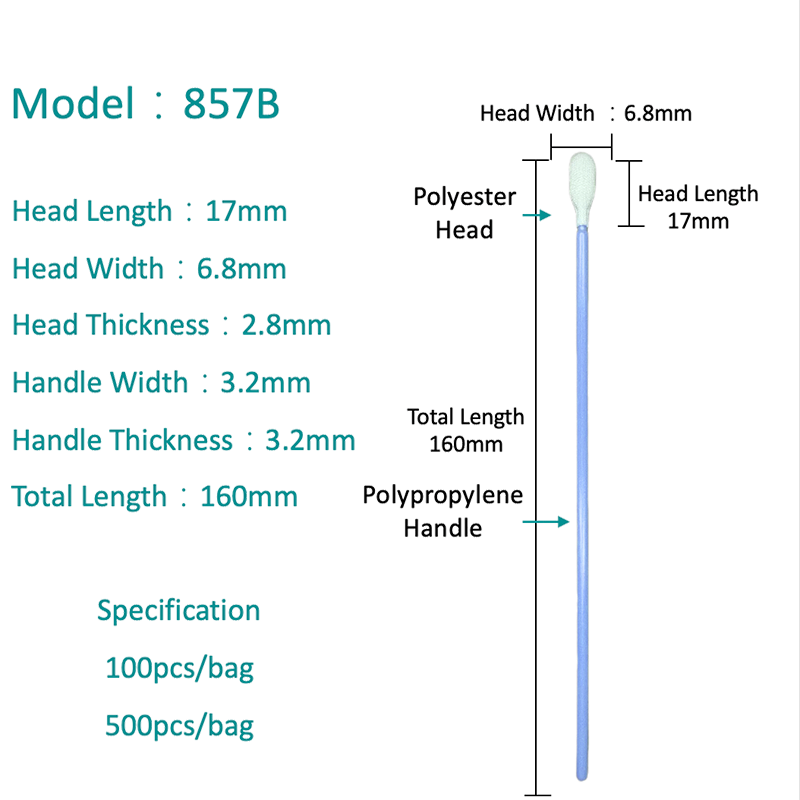
A polyester swab is a precision cleaning and sampling tool consisting of a polyester knit or woven tip bonded to a handle made from polypropylene, nylon, or another low-shedding material. Unlike cotton swabs, which are made from natural cellulose fibers, polyester swabs are constructed entirely from synthetic materials — a distinction that makes them far better suited to controlled environments, sensitive surfaces, and analytical applications where fiber contamination, extractable residues, or particle generation must be minimized.
The tip of a polyester swab is typically made from continuous-filament polyester knit fabric wrapped tightly around a foam or molded core. The continuous filament construction means the individual fibers are not cut — they run in long, unbroken loops through the knit structure — which dramatically reduces loose fiber shedding compared to materials like cotton or rayon, where cut fiber ends are constantly present at the tip surface.
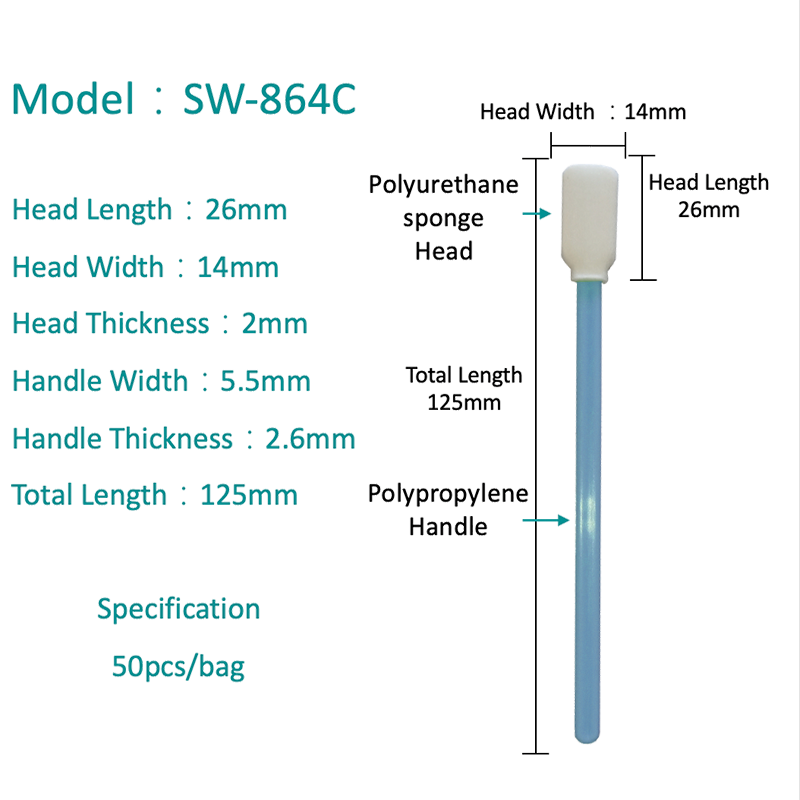
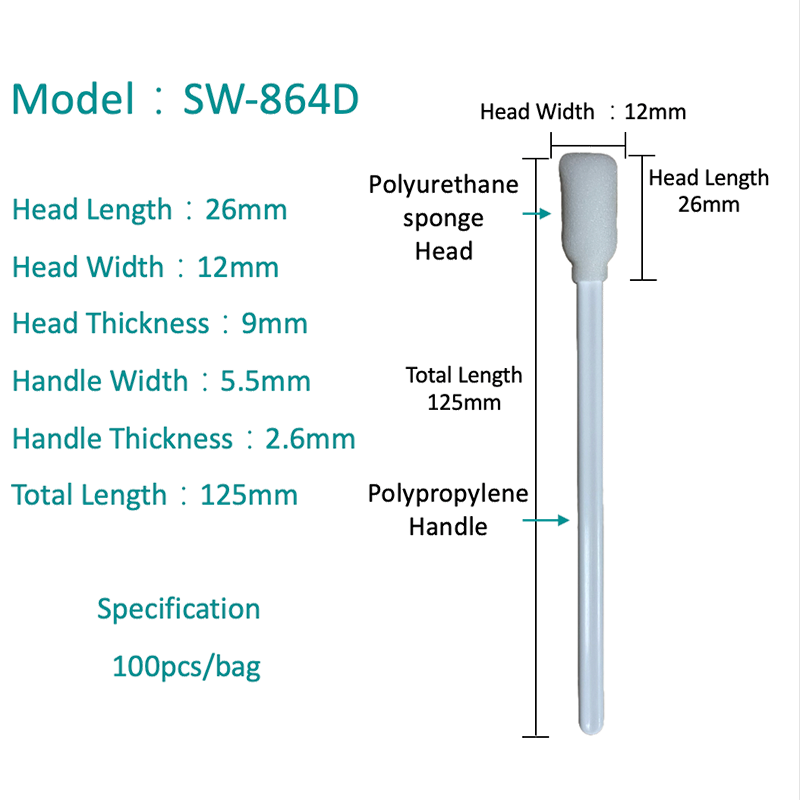
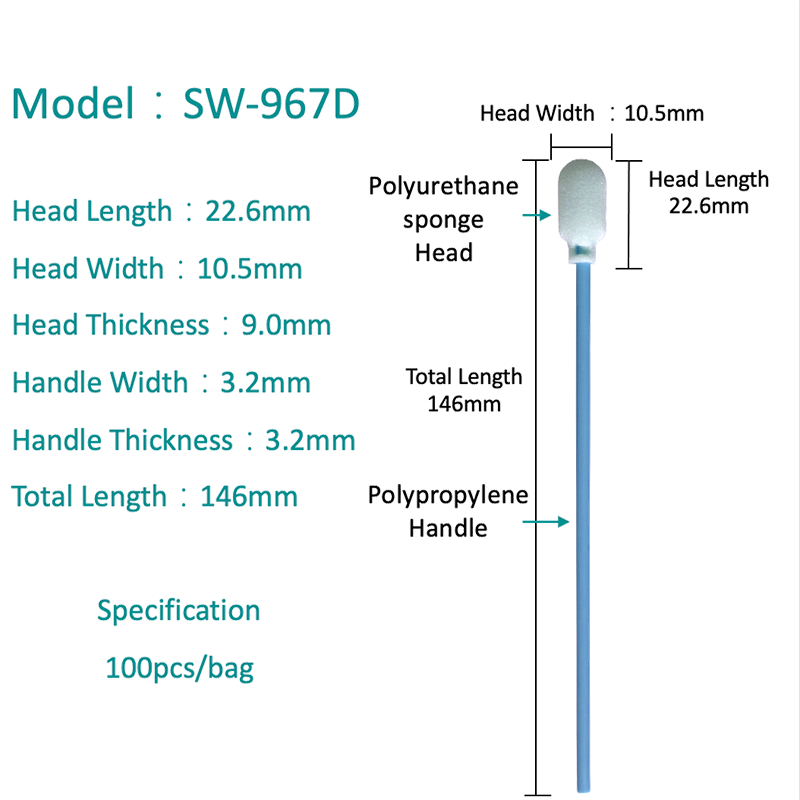
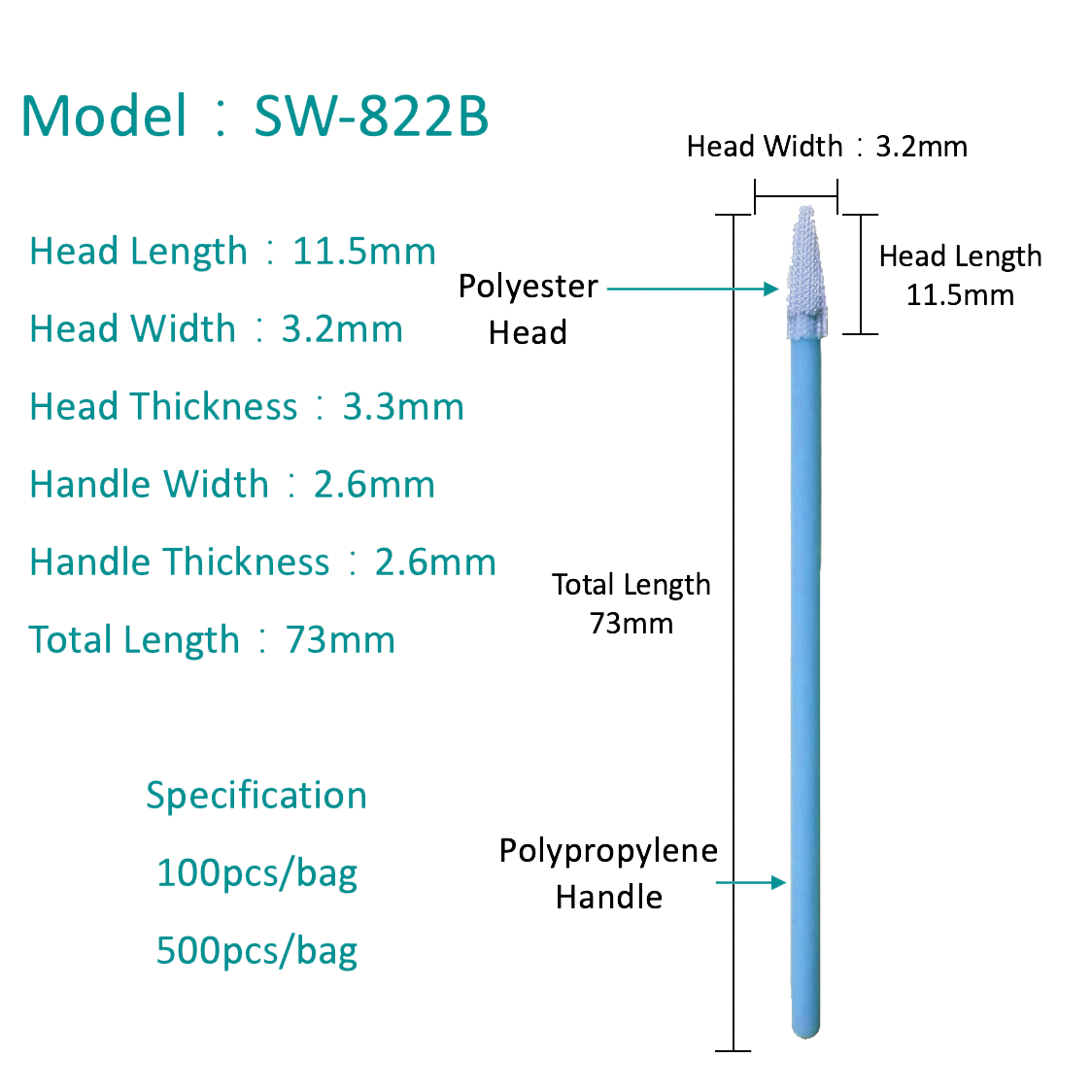
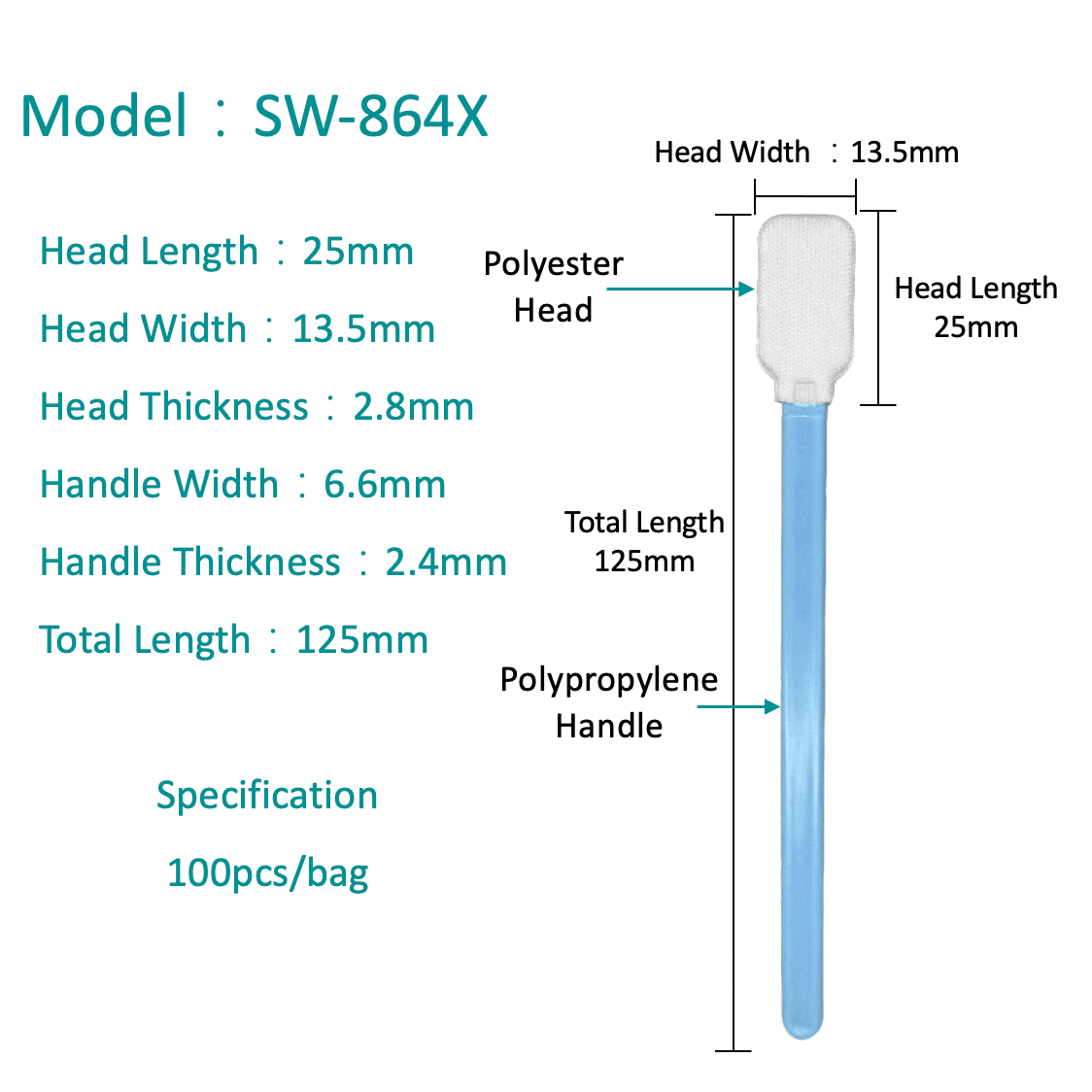
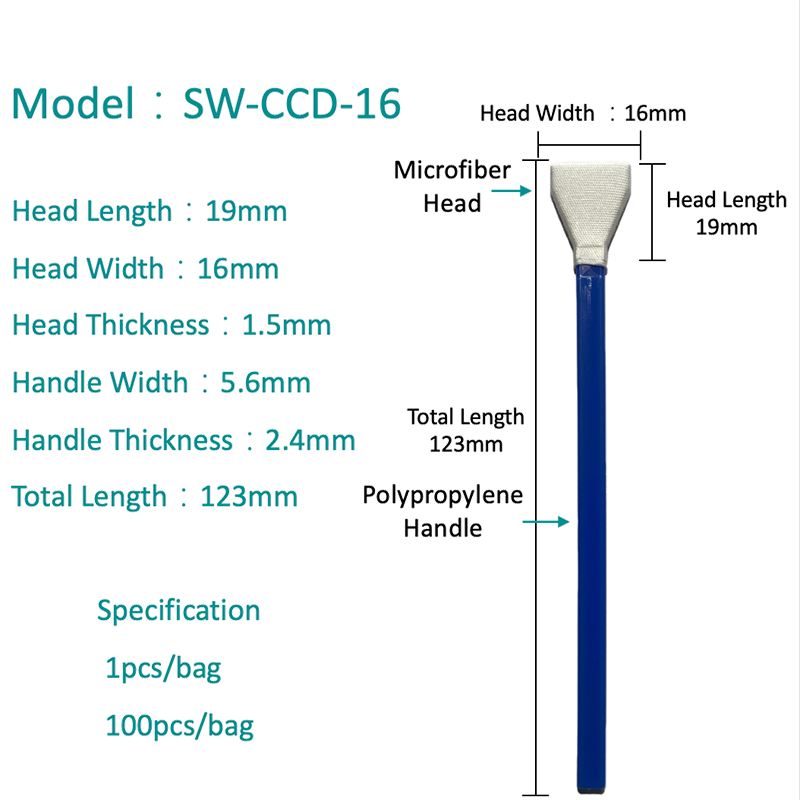
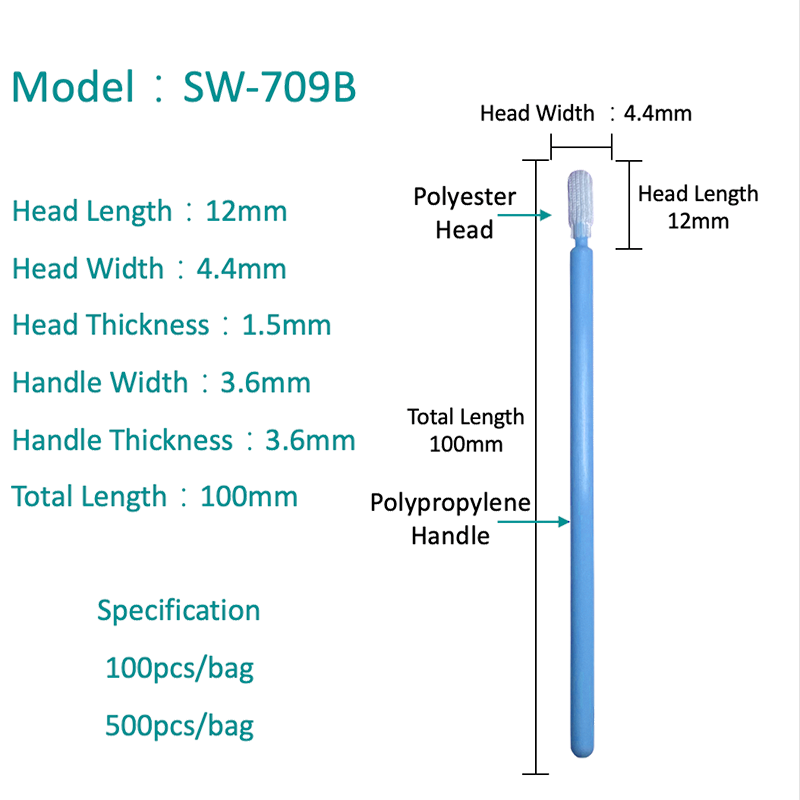
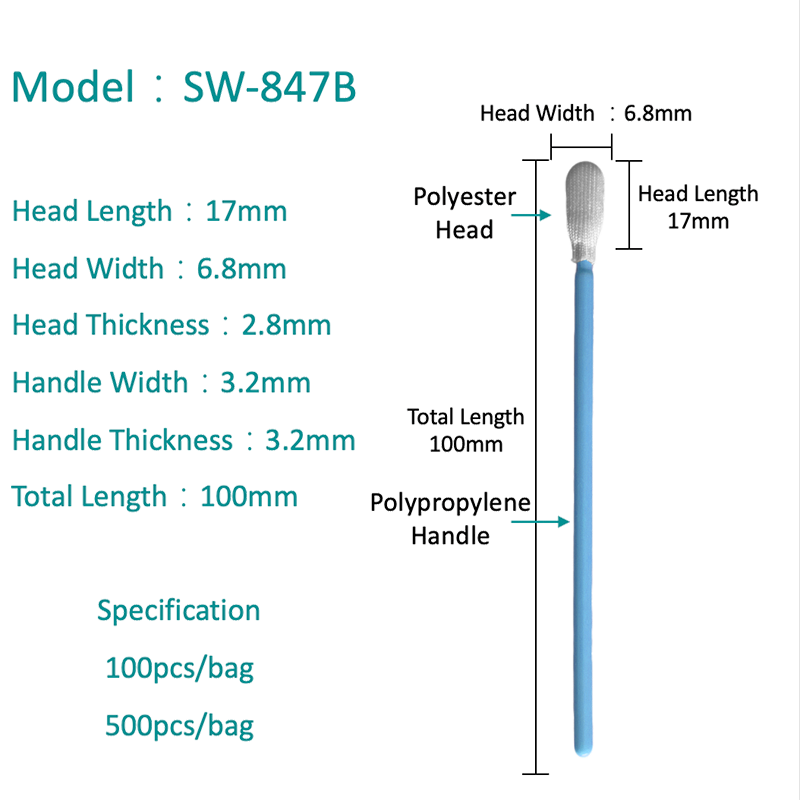
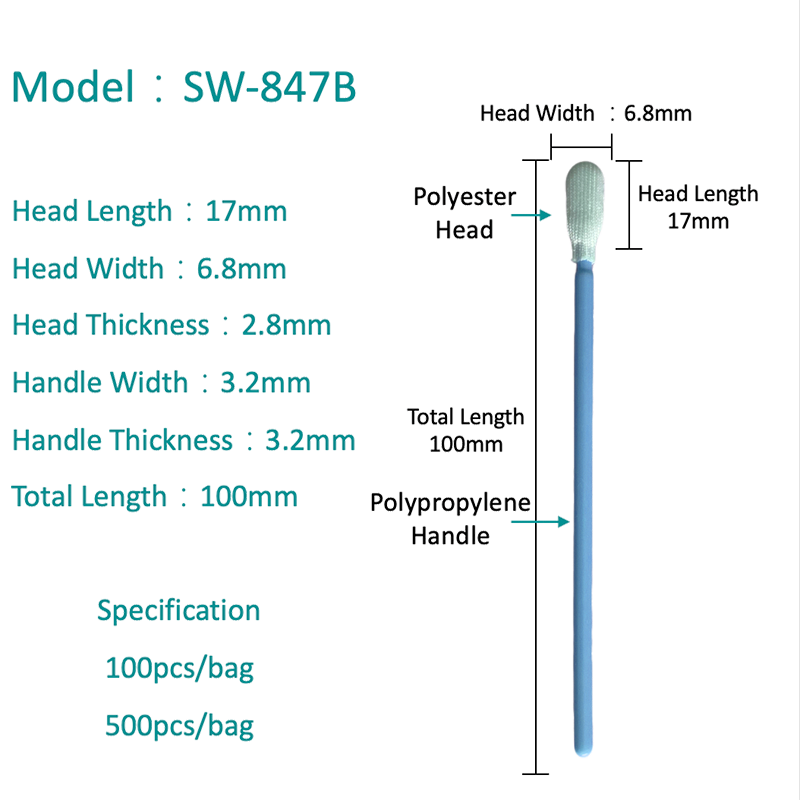
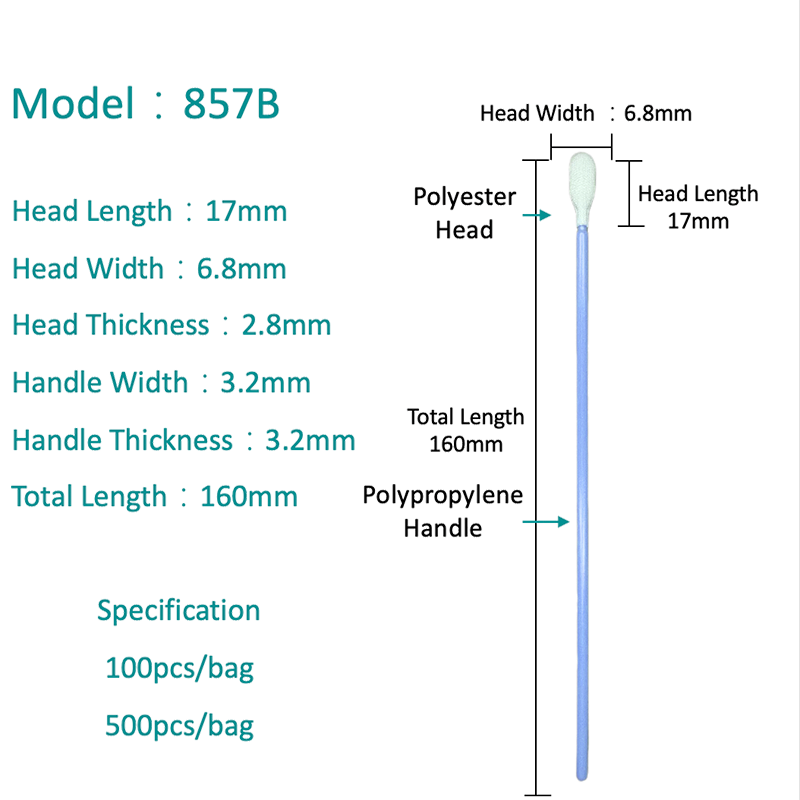
Polyester swabs are produced in a wide range of tip geometries — rectangular paddle tips, pointed tips, round bulb tips, and foam-core variants — each optimized for a specific cleaning or sampling task. Handle lengths typically range from 3 inches to 6 inches, and tip sizes from under 5mm for precision electronics work to 15mm or larger for surface wiping applications.
Polyester vs. Other Swab Materials
Swab tips can be manufactured from several different materials, each with distinct performance characteristics. Understanding how polyester compares to the alternatives explains why it is the preferred material for many precision and cleanroom applications.
| Tip Material | Fiber Type | Particle Generation | Solvent Compatibility | Extractables | Best For |
|---|---|---|---|---|---|
| Polyester knit | Continuous filament synthetic | Very low | Excellent (IPA, acetone, MEK) | Very low | Cleanrooms, electronics, optics |
| Cotton | Natural staple fiber | High | Poor with many solvents | High (oils, sugars, proteins) | General purpose, medical swabs |
| Foam (open cell polyurethane) | Synthetic foam matrix | Low to moderate | Good, but degrades with strong solvents | Low | High fluid absorption, disk drives |
| Nylon knit | Continuous filament synthetic | Very low | Good | Very low | Microbiological sampling, forensics |
| Rayon / viscose | Regenerated cellulose | Moderate | Moderate | Moderate | Printing, general industrial cleaning |
The two properties that most consistently distinguish polyester from alternatives are low extractables and solvent resistance. Extractables are the chemical residues that leach out of the swab material when it contacts a solvent — oils, surfactants, plasticizers, finishing agents, and processing chemicals left in the fiber from manufacturing. Cotton swabs in particular carry significant levels of naturally occurring oils, waxes, and proteins from the cotton plant, as well as processing additives. Polyester, being a chemically inert synthetic, contributes far fewer residues, which matters enormously in applications where surface cleanliness is measured analytically after cleaning.
What Are Cleanroom Polyester Swabs?
A cleanroom polyester swab is a polyester swab that has been manufactured, processed, and packaged under controlled conditions to meet the particle, bioburden, and contamination standards required for use in classified cleanroom environments. The swab itself may be identical in construction to a standard polyester swab, but the production and packaging process is held to a substantially higher standard.
The critical distinction is where and how the swab is made and packaged. Cleanroom polyester swabs are produced in ISO-classified manufacturing environments — typically ISO Class 5 or ISO Class 7 — where airborne particle counts, personnel gowning, surface cleanliness, and environmental monitoring are all tightly controlled. Finished swabs are cleaned (often ultrasonically or by rinsing in ultrapure water and/or IPA), inspected under magnification, and then individually or lot-packaged in sealed pouches inside the cleanroom before being shipped.
This controlled production process results in swabs that carry a verified low particle burden on delivery — the user does not introduce particulate contamination by opening the package and using the swab, because the swab itself has been confirmed to be clean. For standard polyester swabs not manufactured to cleanroom standards, the swab may have accumulated particles during production, handling, and packaging in a conventional environment, making it unsuitable for use in ISO Class 5 or cleaner environments without pre-cleaning.
Cleanroom Classifications and Swab Selection
Cleanrooms are classified by the maximum permissible concentration of airborne particles of a given size per cubic meter of air, as defined by ISO 14644-1. The ISO class number runs from ISO Class 1 (the most stringent, near particle-free) to ISO Class 9 (equivalent to ordinary room air). Most pharmaceutical, semiconductor, and precision optics cleanrooms operate between ISO Class 5 and ISO Class 8.
Swab selection should be matched to the cleanroom classification and the sensitivity of the process:
- ISO Class 5 and cleaner (semiconductor wafer fab, advanced optics, hard disk manufacturing): Requires cleanroom-certified polyester swabs with documented particle counts, low non-volatile residue (NVR) levels, and individual or double-bagged sterile packaging. Tip construction is typically continuous-filament polyester over a polypropylene or nylon handle with no adhesive in the bond zone.
- ISO Class 6–7 (pharmaceutical manufacturing, medical device assembly, aerospace): Cleanroom polyester swabs are standard. Lot-certified NVR and particle data are typically required. Sterile versions (gamma-irradiated or EtO-sterilized) are specified for aseptic processing areas.
- ISO Class 8 (general electronics assembly, precision mechanical work): High-quality polyester swabs processed in a cleanroom environment are appropriate. Full certification documentation may not be required, but low-extractable, low-particle construction remains important.
Key certification data that reputable cleanroom swab suppliers provide with each lot includes: non-volatile residue (NVR) measured in micrograms per swab, particle counts per swab at defined size thresholds (typically ≥0.5 µm and ≥5 µm), ionic contamination levels (relevant for electronics), and — for sterile versions — sterility assurance level (SAL) and bioburden data.
Applications of Polyester and Cleanroom Polyester Swabs
Polyester swabs are specified across a broad range of industries wherever surface cleanliness, low contamination risk, and solvent compatibility are priorities.
Semiconductor and Microelectronics
Wafer fabrication equipment requires routine cleaning of chambers, chucks, load ports, and tooling with solvents including IPA, acetone, and specialty cleaning agents. Cleanroom polyester swabs are used to remove particulate contamination from precision surfaces without introducing new particles or chemical residues that could cause yield loss. In hard disk drive manufacturing, polyester swabs clean read/write head assemblies and disk surfaces where even sub-micron contamination is catastrophic.
Optics and Photonics
Lens cleaning, fiber optic connector end-face cleaning, and laser optic maintenance all rely on polyester swabs. The low-lint, low-NVR characteristics of polyester ensure that cleaning with IPA leaves no smear residue that would scatter light or degrade optical performance. Pointed-tip polyester swabs are widely used for cleaning the recessed end faces of fiber optic connectors in telecommunications and data center applications.
Pharmaceutical and Medical Device Manufacturing
In pharmaceutical cleanrooms, polyester swabs are used for equipment surface sampling as part of cleaning validation programs. Swabs are wiped across defined surface areas of processing equipment after cleaning, then extracted and analyzed by HPLC or TOC to verify that active pharmaceutical ingredient (API) residues are below acceptance limits. Sterile, individually packaged cleanroom polyester swabs are required for swabbing in aseptic processing zones.
Aerospace and Defense
Precision cleaning of aerospace components — fuel system parts, guidance system housings, optical sensors, and connector contacts — requires swabs that will not leave residues that could interfere with adhesive bonding, electrical conductivity, or fluid flow. Polyester swabs with documented NVR levels are commonly specified in aerospace cleaning process sheets and MIL-spec cleaning procedures.
Printed Circuit Board Assembly
Polyester swabs are used in PCB rework and repair to apply flux, clean solder joints with IPA, remove excess adhesive, and clean connector contacts and test points. Their resistance to common electronics cleaning solvents and low ionic contamination make them preferable to cotton for any cleaning that must leave the board surface residue-free before conformal coating or final inspection.
Selecting the Right Polyester Swab: Key Specification Parameters
With dozens of polyester swab configurations available from multiple suppliers, specifying the correct swab for a given application requires evaluating several parameters systematically.
- Tip geometry: Rectangular paddle tips maximize surface contact for wiping broad areas; pointed tips access tight spaces and recessed connectors; round bulb tips are used for gentle cleaning of curved surfaces. Matching tip geometry to the surface being cleaned prevents incomplete coverage or physical damage.
- Handle material and rigidity: Polypropylene handles are standard and chemically resistant. Nylon handles offer higher rigidity for applications requiring firm pressure. Flexible handles allow access to angled or recessed surfaces. The handle must not flex so much that the tip loses controlled contact pressure.
- Cleanroom certification level: Verify that the supplier provides lot-specific test data for NVR, particle counts, and ionic contamination — not just generic product claims. ISO Class 5-compatible swabs require tighter particle limits than Class 7 products.
- Sterility: Sterile swabs (SAL 10⁻⁶) are required for aseptic pharmaceutical environments and some medical device manufacturing steps. Sterility is typically achieved by gamma irradiation or ethylene oxide (EtO) treatment after final packaging.
- Packaging format: Individual pouches minimize contamination at point of use and are required in the most sensitive environments. Bulk packaging in bags is acceptable for less critical applications. Double-bagging provides an additional particle barrier when the outer bag is opened outside the cleanroom and the inner bag is opened inside.
- Solvent pre-saturation: Some cleanroom polyester swabs are supplied pre-saturated with IPA or other solvents, eliminating the solvent dispensing step at the point of use and reducing the risk of contamination from solvent handling inside the cleanroom.

 ADDRESS
 CONTACT
 FAX
FAX EMAIL
EMAIL
