



 English
  中文简体
中文简体 
HOME / NEWS / Industry News / Sponge Swabs for Medical Use: Wound, Surgical & Dental Guide
Medical & Healthcare Supplies
Content
- 1 Sponge Swabs for Medical Use: Wound Care, Surgical, and Dental Applications
- 2 What Is a Sponge Swab Used for in Healthcare?
- 3 Sponge Swab for Wound Cleaning and Wound Care
- 4 Sterile Sponge Swab for Wound Care
- 5 Sponge Swab for Medical Use: Beyond Wound Care
- 6 Sponge Swab for Surgical Procedures
- 7 Sponge Swab for Dental Procedures and Oral Care
- 8 How to Choose a Sponge Swab
Sponge Swabs for Medical Use: Wound Care, Surgical, and Dental Applications
Sponge swabs show up across nearly every corner of clinical care — wound cleaning, oral hygiene, surgical prep, and dental procedures — but the right swab for each task depends on its absorbency, sterility, and handle design. This guide covers where medical sponge swabs are used, what separates a good one from a poor one, and how to choose the right type for a specific clinical task.
What Is a Sponge Swab Used for in Healthcare?
In a healthcare setting, a sponge swab is a small absorbent sponge head, usually mounted on a plastic or paper stick, used to apply, remove, or collect fluid from a targeted area with more control and less trauma than gauze or a cotton-tipped applicator. The sponge material is soft and highly absorbent, which allows it to cleanse a wound or mucosal surface gently while still lifting debris, secretions, or residue effectively.
Wound Care
Gently cleanses wound beds and surrounding skin without introducing abrasive friction.
Oral Care
Moistens and cleans the mouth for patients unable to brush normally.
Surgical Use
Absorbs fluid and preps surgical sites with controlled, precise contact.
Dental Procedures
Applies solutions or absorbs fluid in confined areas of the mouth.
Compared to gauze, a sponge swab offers more precise, localized contact, which matters in situations where the care provider needs to target a small area without disturbing surrounding tissue. Compared to a cotton-tipped applicator, sponge swabs generally hold and release more fluid, and are far less likely to leave fibers behind on a wound or mucosal surface.
Sponge Swab for Wound Cleaning and Wound Care
Sponge swabs used for wound cleaning are designed to remove debris, exudate, and light residue from a wound bed and the surrounding skin while minimizing additional trauma to healing tissue. The soft, absorbent sponge conforms gently to the wound surface rather than scraping across it, which is particularly important for fragile healing tissue, pressure injuries, or wounds in patients with skin that bruises or tears easily.
For wound care specifically, technique matters as much as the swab itself. Standard practice is to clean from the center of the wound outward, or from the least contaminated to the most contaminated area, using a fresh swab for each pass rather than reusing a soiled swab across the wound. This single-pass technique reduces the risk of reintroducing debris or bacteria back into the wound bed.
Sponge swabs are also commonly used to gently apply saline, wound cleansers, or topical medications directly to a wound site, offering more controlled application than pouring or spraying alone, especially on smaller or irregularly shaped wounds.
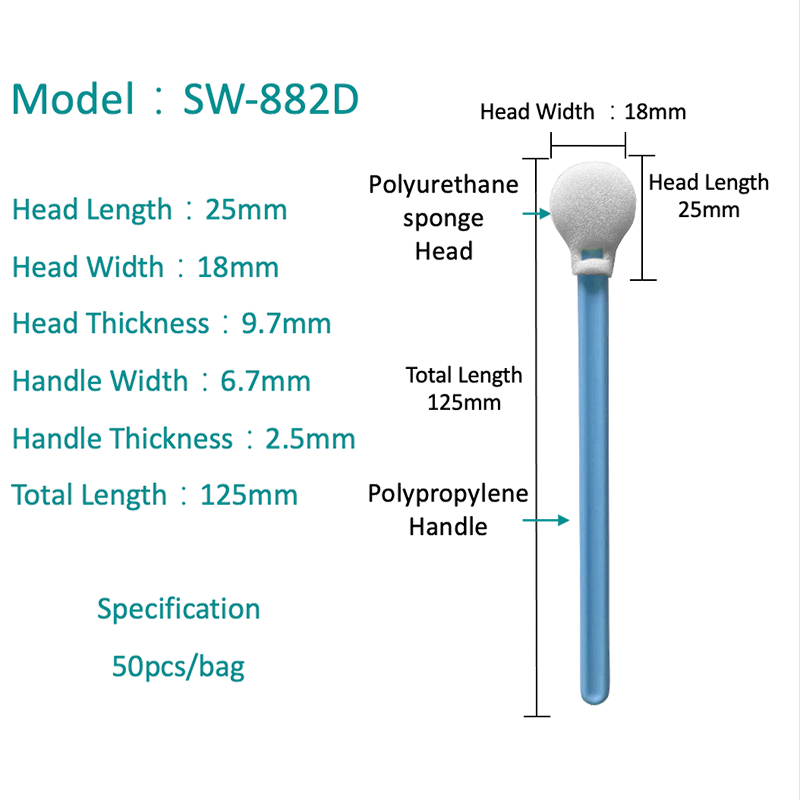
Sterile Sponge Swab for Wound Care
Sterility is a non-negotiable requirement for any swab used directly on an open wound, since introducing bacteria into compromised skin significantly raises infection risk. Sterile sponge swabs for wound care are individually packaged and sterilized (typically via ethylene oxide or gamma irradiation) to remain contamination-free until the package is opened immediately before use.
Individually wrapped packaging confirms the swab has remained sterile since sterilization and hasn't been exposed to contamination in bulk storage.
Single-use design — sterile wound care swabs should never be reused between patients or even between separate cleaning passes on the same wound.
Intact packaging inspection — always check that the sterile packaging is undamaged and unexpired before use; a compromised seal means the contents can no longer be considered sterile.
Sponge Swab for Medical Use: Beyond Wound Care
Beyond direct wound cleaning, sponge swabs for medical use appear throughout general patient care. They're commonly used for skin prep before injections or minor procedures, for applying topical antiseptics, and for general hygiene tasks with patients who have limited mobility or are unable to perform self-care tasks independently. Their absorbency also makes them useful for controlled fluid removal in settings where precision matters more than raw absorbent capacity, such as around IV sites, drain sites, or other small, sensitive areas requiring careful attention.
Sponge Swab for Surgical Procedures
In a surgical setting, sponge swabs serve several distinct roles: prepping the surgical site with antiseptic solution, absorbing blood or fluid during the procedure, and assisting with irrigation or cleanup around the surgical field. Surgical-grade sponge swabs are typically sterile, latex-free (to avoid triggering allergic reactions), and low-linting, since any fibers left behind in a surgical site can complicate healing or introduce a foreign body risk.
Handle design matters more in surgical use than in many other applications. A rigid, easy-to-grip handle allows the surgical team to maintain precise control during use, and radiopaque markers (visible on X-ray) are sometimes built into surgical sponge products to reduce the risk of a retained item being left inside a patient — a well-documented and preventable surgical complication.
Sponge Swab for Dental Procedures and Oral Care
Sponge swabs for dental procedures are used to apply topical anesthetics, absorb saliva or blood in a confined treatment area, and clean small areas of the mouth during procedures where gauze would be too bulky to maneuver precisely. Their small, angled heads allow access to areas that are difficult to reach with larger absorbent materials, which matters in the tight working space of a dental treatment area.
For general oral care — as opposed to a specific dental procedure — sponge swabs are widely used with patients who cannot brush their teeth normally, including those who are unconscious, have swallowing difficulties, or are recovering from oral surgery. Pre-moistened oral care sponge swabs, sometimes infused with a mild flavoring or antibacterial solution, gently clean the gums, tongue, and inside of the cheeks without the abrasive action of a toothbrush, reducing the risk of trauma to sensitive or healing oral tissue.
How to Choose a Sponge Swab
Sterility requirement: confirm sterile packaging for any use directly on open wounds, mucosal tissue, or surgical sites.
Absorbency needs: higher-absorbency sponges suit fluid removal tasks; lower-absorbency, more controlled release suits topical application.
Handle material and length: rigid plastic handles offer more control for precise tasks; longer handles help reach confined areas like the back of the mouth.
Latex-free construction: essential for patients with latex sensitivities or allergies, and increasingly a standard requirement across clinical settings.
Low-linting material: particularly important for surgical and wound applications, where fiber shedding can complicate healing or introduce contamination.
Single-use vs. bulk packaging: individually wrapped sterile swabs for clinical procedures; bulk non-sterile packaging is appropriate only for general, non-invasive hygiene tasks.
Matching sterility, absorbency, and handle design to the specific clinical task — rather than treating all sponge swabs as interchangeable — is what separates a swab that supports safe, effective care from one that introduces unnecessary risk, particularly in wound care and surgical settings where infection control is critical.




 ADDRESS
 CONTACT
 FAX
FAX EMAIL
EMAIL
